


Page 63 - (DK Eyewitness) Travel Guide - Austria
P. 63
INNER CIT Y 61
5 Mozarthaus historical objects: insignia of as Madonna and Axe, ever since
Vienna the Grand Masters, coins, an attack during the religious
medals, seals, sacral vessels and wars of the 17th century. The
Domgasse 5. Map 2 C4. table ware, and masterpieces of Moses Fountain in front of the
Tel 51 21 791. % Stephansplatz. European art collected by church dates from 1798.
@ 3A. Open 10am–7pm daily.&
8∑ mozarthausvienna.at the knights.
The walls of the church are
Domgasse 5 is the most famous hung with the coats of arms
of Mozart’s various homes in of the Teutonic knights. The
Vienna. He lived here with his beautiful winged altar (1520)
family in 1784–7, and composed is made from elaborate carved
many of his masterpieces here, and painted panels depicting
including The Marriage of Figaro. scenes from the Passion,
Restored for the anniversary surrounded by intricate tracery.
year of 2006, the Mozarthaus Within the complex of
Vienna has exhibitions on two build-ings belonging to the
upper floors as well as the Order is the apartment where
Mozarts’ first-floor flat. Mozart first lived in Vienna,
later occupied by Johannes
6 Deutschordens- Brahms (1863–5).
kirche St Elisabeth 7 Franziskaner-
Singerstrasse 7. Map 2 C4. kirche
Tel 51 21 065. % Stephansplatz.
@ 1A, 2A, 3A. Church: Open 7am– Franziskanerplatz 4. Map 2 C4.
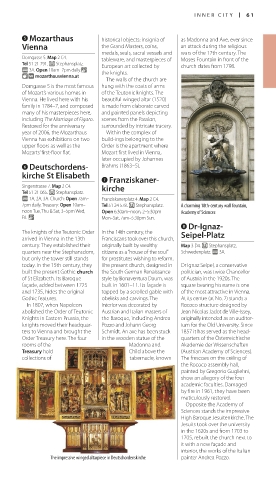
7pm daily. Treasury: Open 10am– Tel 51 24 578. % Stephansplatz. A charming 18th-century wall fountain,
noon Tue, Thu & Sat, 3–5pm Wed, Open 6:30am–noon, 2–5:30pm Academy of Sciences
Fri. & Mon–Sat, 7am–5:30pm Sun.
8 Dr-Ignaz-
The knights of the Teutonic Order In the 14th century, the Seipel-Platz
arrived in Vienna in the 13th Franciscans took over this church,
century. They established their originally built by wealthy Map 3 D4. % Stephansplatz,
quarters near the Stephansdom, citizens as a “house of the soul” Schwedenplatz. @ 3A.
but only the tower still stands for prostitutes wishing to reform.
today. In the 15th century, they The present church, designed in Dr Ignaz Seipel, a conservative
built the present Gothic church the South German Renaissance politician, was twice Chancellor
of St Elizabeth. Its Baroque style by Bonaventura Daum, was of Austria in the 1920s. The
façade, added between 1725 built in 1601–11. Its façade is square bearing his name is one
and 1735, hides the original topped by a scrolled gable with of the most attractive in Vienna.
Gothic features. obelisks and carvings. The At its centre (at No. 2) stands a
In 1807, when Napoleon interior was decorated by Rococo structure designed by
abolished the Order of Teutonic Austrian and Italian masters of Jean Nicolas Jadot de Ville-Issey,
Knights in Eastern Prussia, the the Baroque, including Andrea originally intended as an auditor-
knights moved their headquar- Pozzo and Johann Georg ium for the Old University. Since
ters to Vienna and brought the Schmidt. An axe has been stuck 1857 it has served as the head-
Order Treasury here. The four in the wooden statue of the quarters of the Österreichische
rooms of the Madonna and Akademie der Wissenschaften
Treasury hold Child above the (Austrian Academy of Sciences).
collections of tabernacle, known The frescoes on the ceiling of
the Rococo assembly hall,
painted by Gregorio Guglielmi,
show an allegory of the four
academic faculties. Damaged
by fire in 1961, they have been
meticu lously restored.
Opposite the Academy of
Sciences stands the impressive
High Baroque Jesuitenkirche. The
Jesuits took over the university
in the 1620s and from 1703 to
1705, rebuilt the church next to
it with a new façade and
interior, the works of the Italian
The impressive winged altarpiece in Deutschordenskirche painter Andrea Pozzo.
060-061_EW_Austria.indd 61 12/09/17 3:02 pm

