


Page 62 - History of War - Issue 18-15
P. 62
THE FORGOTTEN SIKH REGIMENTS OF THE BRITISH EMPIRE
                  FROMSIKHEMPIRE SOLDIERS


          TOBRITISHREGIMENTS


          WRITERANDBROADCASTERJAYSINGHSOHALONTHEHISTORYANDMAKEUP OF BRITISHARMYSIKHREGIMENTS
          WASITEASYFORTHESIKHSTOCHANGE         which includes uncut hair and a dagger. Observing “THE DISCIPLINE OF A SIKH
                                               Singh and maintaining the Five Ks on his person,
          THEIR ALLEGIANCE AFTER BEING PART OF A
          LONG-STANDING EMPIRE?                meat and intoxicants and thinking of women other COMES FROM HIS ADHERENCE
                                               daily prayers and living a simple lifestyle, shunning
          ThePunjabwasalwaysalandofconflict,dueto
                                               than his spouse as mothers or sisters are also
          subjugation of non-Muslims during Mughal rule,  expected.TheBritishgavetheSikhsanopportunity TO HIS FAITH”
          the persecution of Sikhs and Hindus, and the
          Pathan invasions. But Maharaja Ranjit Singh had  toliveamartiallifestyle;somewouldhavewanted
          brought a period of stability that enabled people  to relive the heroics of their forebears while others  1914,theyweresenttoeverytheatretheBritish
          from all backgrounds to prosper. The Sikh kingdom  sawanincomeawayfromfarming.AsmoreSikh  were engaged in, not just on the Western Front but in
          wasasecularone,andwhileundivided,Punjab  mencameforwardtoserveinBritishunits,so  Mesopotamia, Gallipoli, Suez, and Tsingtao in China.
          (now split between Pakistan and India) was the  British officers saw the merit of organising them
          home of the Sikh people where the Sikh Gurus had  inmoreformalways.ButitwasnotuntiltheIndia  HOW WERE THE SIKH REGIMENTS LOOKED
          established the faith and community. It was a land  Mutiny of 1857 when some class-based regiments  UPON BY THE REST OF THE BRITISH ARMY?
          whereallfaithslivedpeacefullysidebyside.The  revolted against Britain that the loyalty and valour  With respect. These regiments had gained a name
          decayoftheSikhEmpireafterthedeathofRanjit  oftheSikhswasbestdemonstrated.  for themselves fi ghting against the British, and
          broughtaboutmuchturmoil,whichthreateneda  From irregular forces to military police battalions  shown their loyalty and valour on the frontier. They
          return to sectarian divisions.       and Sikh regiments of the Bengal Infantry, they  were seen by the rest of the British Army (and
           SoitwasmucheasierfortheBritishtopromote  evolved with their own uniforms and customs,  indeed foreign armies) as the envy of an empire in
          themselves as being crucial for continued peace  which empowered and emboldened the men  which the British could call to service those gallant
          andsecurityinthePunjab,aslongastheywere  serving in them. They were unique in that Sikhs  warriors that live within its territories. A sign of this
          fairandrespectedthedistinctcustomsand  wishingtojoinwouldhavetobebaptisedintothe  immense respect and gratitude is the inspiration
          traditionsofthethreefaithsanddidnotcause  Khalsa and swear an oath of loyalty, not just to the  to name a warship after this martial race: the HMS
          offence to these sentiments.         crownbuttotheregiment.Itwastakenasagiven  Sikh. The fi rst of its name was a torpedo boat
                                               thataSikhwouldputdownhislifeifrequiredfor  launched in 1889 while the second was an S-class
          HOWWERESIKHREGIMENTSCREATED          both,becaus hehadgivenhisword.        DestroyerlaunchedattheendofWorldWarIin
          ANDMADEUPINTHEBRITISHARMY?WAS                                              1918. The third HMS Sikh came into service in  Evans, Getty, National Archives
          THERE ANYTHING UNIQUE ABOUT THEM?    HOW DID T                             1938, and during World War II was involved in the
          The recruitment of Sikhs into the frontier force  THE BRITI                     the Bismarck.
          enabledtheBritishtokeepthoseoffightingage  TIRAH CA
          and stock away from Punjab, but it also enabled  The Sikhs
          themtogetacloserlookatwhatmadetheSikhs  the conflic
          so good on the battlefield.          global, th
           ThedisciplineofaSikhcomesfromhis         a
          adherence to his faith – taking bapt
          as instructed by the tenth Guru Gob

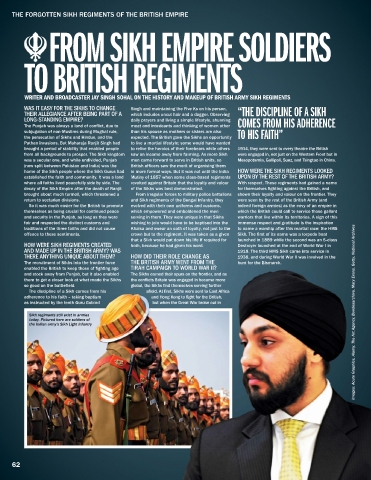
           Sikh regiments still exist in armies
           today. Pictured here are soldiers of
           the Indian army’s Sikh Light Infantry


     62

