


Page 80 - History of War - Issue 18-15
P. 80
HITLER’S ENGINEER


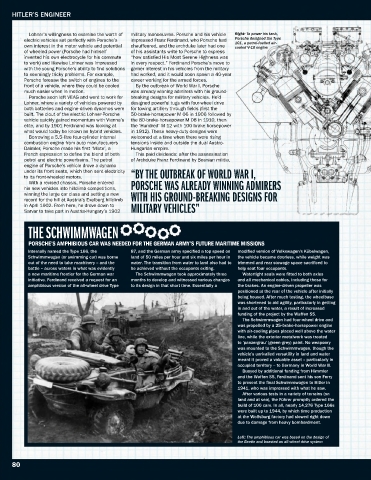
           Lohner’s willingness to examine the worth of  military manoeuvres. Porsche and his vehicle   Right: To power his tank,
                                                                                    Porsche designed the Type
          electric vehicles sat perfectly with Porsche’s   impressed Franz Ferdinand, who Porsche had
                                                                                    101,apetrol-fuelledair-
          own interest in the motor vehicle and potential   chauffeured, and the archduke later had one   cooled V-10 engine
          of wheeled power (Porsche had himself   of his assistants write to Porsche to express
          invented his own electrocycle for his commute   “how satisfi ed His Most Serene Highness was
          to work) and likewise Lohner was impressed   in every respect.” Ferdinand Porsche’s move to
          with the young Porsche’s ability to fi nd solutions  garner interest in his vehicles from the military
          to seemingly tricky problems. For example,   had worked, and it would soon spawn a 40-year
          Porsche foresaw the switch of engines to the   career working for the armed forces.
          front of a vehicle, where they could be cooled   By the outbreak of World War I, Porsche
          much easier when in motion.          was already winning admirers with his ground-
           Porsche soon left VEAG and went to work for  breaking designs for military vehicles. He’d
          Lohner, where a variety of vehicles powered by   designed powerful tugs with four-wheel drive
          both batteries and engine-driven dynamos were  for towing artillery through fi elds (fi rst the
          built. The clout of the electric Lohner-Porsche   50-brake-horsepower M 06 in 1906 followed by
          vehicle quickly gained momentum with Vienna’s  the 80-brake-horsepower M 08 in 1910, then
          elite, and by 1901 Ferdinand was looking at   the ‘Hundred’ M 12 with 100 brake horsepower
          what would today be known as hybrid vehicles.   in 1912). These heavy-duty designs were
           Borrowing a 5.5-litre four-cylinder internal   welcomed at a time when there were rising
          combustion engine from auto manufacturers   tensions inside and outside the dual Austro-
          Daimler, Porsche made his fi rst ‘Mixte’, a   Hungarian empire.
          French expression to defi ne the blend of both   This paid dividends: after the assassination
          petrol and electric powertrains. The petrol   of Archduke Franz Ferdinand by Bosnian militia,
          engine of Porsche’s vehicle drove a dynamo
          under its front seats, which then sent electricity  “BY THE OUTBREAK OF WORLD WAR I,
          to its front-wheeled motors.
          his new vehicles into hillclimb competitions,  PORSCHE WAS ALREADY WINNING ADMIRERS
           With a revised chassis, Porsche entered
          record for the hill at Austria’s Exelberg hillclimb WITH HIS GROUND-BREAKING DESIGNS FOR
          winning the large car class and setting a new
          Sarvar to take part in Austria-Hungary’s 1902  MILITARY VEHICLES”
          in April 1902. From here, he drove down to


           THE SCHWIMMWAGEN


           PORSCHE’S AMPHIBIOUS CAR WAS NEEDED FOR THE GERMAN ARMY’S FUTURE MARITIME MISSIONS
           Internally named the Type 166, the   87,andtheGermanarmyspecifiedatopspeedon  modified version of Volkswagen’s Kübelwagen,
           Schwimmwagen (or swimming car) was borne   land of 50 miles per hour and six miles per hour in  the vehicle became doorless, while weight was
           out of the need to take machinery – and the   water.Thetransitionfromwatertolandalsohadto  trimmed and rear stowage space sacrificed to
           battle – across waters in what was evidently   be achieved without the occupants exiting.  help seat four occupants.
           a new maritime frontier for the German war   The Schwimmwagen took approximately three  Watertight seals were fitted to both axles
           initiative. Ferdinand received a request for an   months to develop and witnessed various changes  and all mechanical cables, including those for
           amphibious version of the all-wheel drive Type   toitsdesigninthatshorttime.Essentiallya  the brakes. An engine-driven propeller was
                                                                                     positionedattherearofthevehicleafterinitially
                                                                                     beinghoused.Aftermuchtesting,thewheelbase
                                                                                     wasshortenedtoaidagility,particularlyingetting
                                                                                     inandoutofthewater,aresultofincreased
                                                                                     funding of the project by the Waffen SS.
                                                                                      TheSchwimmwagenhadfour-wheeldriveand
                                                                                     was propelled by a 25-brake-horsepower engine
                                                                                     with air-cooling pipes placed well above the water
                                                                                     line, while the exterior metalwork was treated
                                                                                     to ‘panzergrau’ (green-grey) paint. No weaponry
                                                                                     was mounted to the Schwimmwagen, though the
                                                                                     vehicle’s unrivalled versatility in land and water
                                                                                     meantitprovedavaluableasset–particularlyin
                                                                                     occupied territory – to Germany in World War II.
                                                                                      Buoyed by additional funding from Himmler
                                                                                     and the Waffen SS, Ferdinand sent his son Ferry
                                                                                     topresentthefinalSchwimmwagentoHitlerin
                                                                                     1941, who was impressed with what he saw.
                                                                                      Aftervarioustestsinavarietyofterrains(on
                                                                                     landandatsea),theFührerpromptlyorderedthe
                                                                                     buildof100cars.Inall,nearly14,276Type166s
                                                                                     were built up to 1944, by which time production
                                                                                     attheWolfsburgfactoryhadslowedrightdown
                                                                                     duetodamagefromheavybombardment.


                                                                                     Left: The amphibious car was based on the design of
                                                                                     the Beetle and boasted an all-wheel drive system


     80

