


Page 82 - History of War - Issue 18-15
P. 82
HITLER’S ENGINEER


          Porsche’s products were heavily used in the
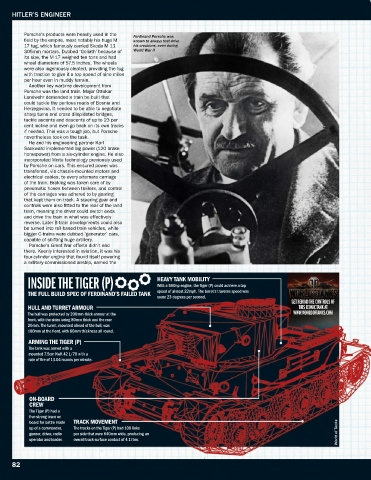
                                                Ferdinand Porsche was
          fi eld by the empire, most notably his huge M   known to always test-drive
          17 tug, which famously carried Skoda M 11   his creations, even during
          305mm mortars. Dubbed ‘Goliath’ because of   World War II
          its size, the M 17 weighed ten tons and had
          wheel diameters of 57.5 inches. The wheels
          were also ingeniously cleated, providing the tug
          with traction to give it a top speed of nine miles
          per hour even in muddy terrain.
           Another key wartime development from
          Porsche was the land train. Major Ottokar
          Landwehr demanded a train be built that
          could tackle the perilous roads of Bosnia and
          Herzegovina. It needed to be able to negotiate
          sharp turns and cross dilapidated bridges,
          tackle ascents and descents of up to 23 per
          cent incline and even go back on its own tracks
          if needed. This was a tough job, but Porsche
          nevertheless took on the task.
           He and his engineering partner Karl
          Sackward implemented big power (120 brake
          horsepower) from a six-cylinder engine. He also
          incorporated Mixte technology previously used
          by Porsche on cars. This ensured power was
          transferred, via chassis-mounted motors and
          electrical cables, to every alternate carriage
          of the train. Braking was taken care of by
          pneumatic hoses between trailers, and control
          of the carriages was adhered to by gearing
          that kept them on track. A steering gear and
          controls were also fi tted to the rear of the land
          train, meaning the driver could switch ends
          and drive the train in what was effectively
          reverse. Later B-train developments could also
          be turned into rail-based train vehicles, while
          bigger C-trains were dubbed ‘generator’ cars,
          capable of shifting huge artillery.
           Porsche’s Great War efforts didn’t end
          there. Keenly interested in aviation, it was his
          four-cylinder engine that found itself powering
          a military-commissioned airship, named the

           INSIDE THE TIGER (P)                         HEAVY TANK MOBILITY
                                                        Witha550hpengine,theTiger(P)couldachieveatop
                                                        speed of almost 22mph. The turret’s traverse speed was
           THE FULL BUILD SPEC OF FERDINAND’S FAILED TANK
                                                        some 23 degrees per second.
           HULL AND TURRET ARMOUR
           The hull was protected by 200mm-thick armour at the
           front, with the sides being 80mm thick and the rear
           20mm. The turret, mounted ahead of the hull, was
           100mm at the front, with 80mm thickness all round.
           ARMING THE TIGER (P)
           The tank was armed with a
           mounted 7.5cm KwK 42 L/70 with a
           rate of fi re of 13.04 rounds per minute.


           ON-BOARD
           CREW
           The Tiger (P) had a
           fi ve-strong team on
           board for battle made   TRACK MOVEMENT
           up of a commander,   ThetracksontheTiger(P)had109links
           gunner, driver, radio   persidethatwere640mmwide,producingan                                                 World of Tanks
           operator and loader.  overalltracksurfacecontactof4.175m.


     82

