Page 89 - History of War - Issue 18-15
P. 89
THE WAR IN DARFUR


                                                                                                         desperate Arab cattle
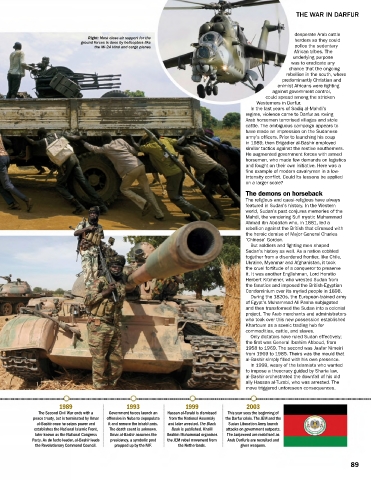
                                Right: Most close air support for the
                             ground forces is done by helicopters like                                   herders so they could
                                  the Mi-24 Hind and cargo planes                                        police the sedentary
                                                                                                        African tribes. The
                                                                                                        underlying purpose
                                                                                                       was to eradicate any
                                                                                                       chance that the ongoing
                                                                                                      rebellion in the south, where
                                                                                                    predominantly Christian and
                                                                                                   animist Africans were fighting
                                                                                                 against government control,
                                                                                              could spread among the stricken
                                                                                           Westerners in Darfur.
                                                                                         In the last years of Sadiq al-Mahdi’s
                                                                                       regime, violence came to Darfur as roving
                                                                                       Arab horsemen terrorised villages and stole
                                                                                       cattle. The ambiguous campaign appears to
                                                                                       have made an impression on the Sudanese
                                                                                       army’s officers. Prior to launching his coup
                                                                                       in 1989, then Brigadier al-Bashir employed
                                                                                       similar tactics against the restive southerners.
                                                                                       He augmented government forces with armed
                                                                                       horsemen, who made few demands on logistics
                                                                                       and fought on their own initiative. Here was a
                                                                                       fine example of modern cavalrymen in a low-
                                                                                       intensity conflict. Could its lessons be applied
                                                                                       on a larger scale?
                                                                                       The demons on horseback
                                                                                       The religious and quasi-religious have always
                                                                                       featured in Sudan’s history. In the Western
                                                                                       world, Sudan’s past conjures memories of the
                                                                                       Mahdi, the wandering Sufi mystic Muhammad
                                                                                       Ahmad ibn Abdallah who, in 1881, led a
                                                                                       rebellion against the British that climaxed with
                                                                                       the heroic demise of Major General Charles
                                                                                       ‘Chinese’ Gordon.
                                                                                         But soldiers and fighting men shaped
                                                                                       Sudan’s history as well. As a nation cobbled
                                                                                       together from a disordered frontier, like Chile,
                                                                                       Ukraine, Myanmar and Afghanistan, it took
                                                                                       the cruel fortitude of a conqueror to preserve
                                                                                       it. It was another Englishman, Lord Horatio
                                                                                       Herbert Kitchener, who wrested Sudan from
                                                                                       the fanatics and imposed the British-Egyptian
                                                                                       Condominium over its myriad people in 1898.
                                                                                         During the 1820s, the European-trained army
                                                                                       of Egypt’s Muhammad Ali Pasha subjugated
                                                                                       and then transformed the Sudan into a colonial
                                                                                       project. The Arab merchants and administrators
                                                                                       who took over this new possession established
                                                                                       Khartoum as a scenic trading hub for
                                                                                       commodities, cattle, and slaves.
                                                                                         Only dictators have ruled Sudan effectively;
                                                                                       the first was General Ibrahim Abboud, from
                                                                                       1958 to 1969. The second was Jaafar Nimeiri
                                                                                       from 1969 to 1985. Theirs was the mould that
                                                                                       al-Bashir simply filled with his own presence.
                                                                                         In 1999, weary of the Islamists who wanted
                                                                                       to impose a theocracy guided by Sharia law,
                                                                                       al-Bashir orchestrated the downfall of his old
                                                                                       ally Hassan al-Turabi, who was arrested. The
                                                                                       move triggered unforeseen consequences.


                      1989                   1993                 1999                  2003
               The Second Civil War ends with a   Government forces launch an   Hassan al-Turabi is dismissed   This year sees the beginning of
             peace treaty, but is terminated by Omar   offensive in Nuba to depopulate   from the National Assembly   the Darfur crisis. The JEM and the
              al-Bashir once he seizes power and   it and remove the inhabitants.   and later arrested. The Black   Sudan Liberation Army launch
             establishes the National Islamic Front,   The death count is unknown.   Book is published. Khalil   attacks on government outposts.
             later known as the National Congress   Omar al-Bashir assumes the   Ibrahim Muhammad organises   The Janjaweed are mobilised as
            Party. As de facto leader, al-Bashir leads   presidency, a symbolic post   the JEM rebel movement from   Arab Darfuris are recruited and
             the Revolutionary Command Council.  propped up by the NIF.  the Netherlands.  given weapons.


                                                                                                                            89
   84   85   86   87   88   89   90   91   92   93   94