


Page 119 - (DK Eyewitness) Travel Guide - Argentina
P. 119
P ALERMO AND BEL GR ANO 117
that around 5,000 people
were interned here during
the so-called “Dirty War.” Most
shocking of all were the cases
of pregnant women who were
detained here, allowed to give
birth, then killed so that their
children could be given up for
adoption to “friends” of the junta.
As part of Argentina’s ongoing
struggle to come to terms with
this dark era, this facility was
converted into Espacio Memoria
y Derechos Humanos
(Remembrance and Human
Rights Center). The grounds of
this complex serve as the head-
quarters of the rights center,
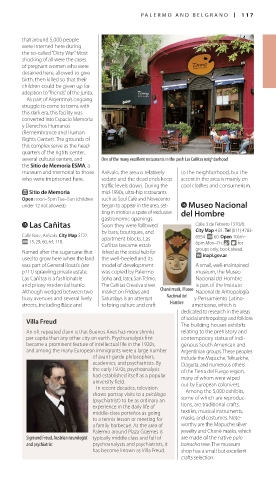
several cultural centers, and One of the many excellent restaurants in the posh Las Cañitas neighborhood
the Sitio de Memoria ESMA, a
museum and memorial to those Arévalo, the area is relatively to the neighborhood, but the
who were imprisoned here. sedate and the dead ends keep accent in the area is mainly on
traffic levels down. During the cool clothes and consumerism.
E Sitio de Memoria mid-1990s, ultra-hip restau rants
Open noon–5pm Tue–Sun (children such as Soul Café and Novecento
under 12 not allowed). began to appear in the area, set- y Museo Nacional
ting in motion a spate of exclusive del Hombre
gastro nomic openings.
t Las Cañitas Soon they were followed Calle 3 de Febrero 1370/8.
by bars, boutiques, and City Map 4 B1. Tel (011) 4783-
Calle Baez, Arévalo. City Map 5 D2. 6554. @ 60. Open 10am–
@ 15, 29, 60, 64, 118. apartment blocks. Las 6pm Mon−Fri. & 8 for
Cañitas became estab-
Named after the sugarcane that lished as the social hub for groups only, book ahead.
∑ inapl.gov.ar
used to grow here when the land the well-heeled and its
was part of General Rosas’s (see model of development A small, well-maintained
p111) sprawling private estate, was copied by Palermo museum, the Museo
Las Cañitas is a fashionable Soho and, later, San Telmo. Nacional del Hombre
and pricey resi dential barrio. The Cañitas Creativa street is part of the Instituto
Although wedged between two market on Fridays and Chané mask, Museo Nacional de Antropología
busy avenues and several lively Saturdays is an attempt Nacional del y Pensamiento Latino-
streets, including Báez and to bring culture and craft Hombre americano, which is
dedicated to research in the areas
Villa Freud of social anthropology and folklore.
The building houses exhibits
An oft-repeated claim is that Buenos Aires has more shrinks relating to the pre history and
per capita than any other city on earth. Psychoanalysis first contemporary status of indi-
became a prominent feature of intellectual life in the 1920s, genous South American and
and among the many European immigrants were a large number Argentinian groups. These peoples
of avant-garde philosophers, include the Mapuche, Tehuelche,
academics, and psychiatrists. By Diaguita, and numerous others
the early 1970s, psychoanalysis of the Tierra del Fuego region,
had established itself as a popular many of whom were wiped
university field. out by European colonizers.
In recent decades, television
shows portray visits to a psicólogo Among the 5,000 exhibits,
(psychiatrist) to be as ordinary an some of which are reproduc-
experience in the daily life of tions, are tradi tio nal crafts,
middle-class porteños as going textiles, musical instruments,
to a tennis lesson or meeting for masks, and costumes. Note-
a family barbecue. As the area of worthy are the Mapuche silver
Palermo around Plaza Güemes is jewelry and Chané masks, which
Sigmund Freud, Austrian neurologist typically middle class and full of are made of the native palo
and psychiatrist psychoanalysts and psychiatrists, it borracho tree. The museum
has become known as Villa Freud. shop has a small but excellent
crafts selection.
116-117_EW_Argentina.indd 117 05/08/16 10:40 am

