


Page 121 - (DK Eyewitness) Travel Guide - Argentina
P. 121
P ALERMO AND BEL GR ANO 119
i Cementerio de
la Chacarita
Ave Guzmán 680 & Federico Lacroze.
City Map 4 A4. Tel (011) 4553-9338.
Federico Lacroze. @ 39, 45, 71, 93.
Open 8am–6pm daily. 8 3pm, 2nd &
4th Sat. 7
Buenos Aires’s largest cemetery,
though not its most famous or
aristocratic, was inaugurated in
the wake of the yellow fever
epidemic that swept the city in
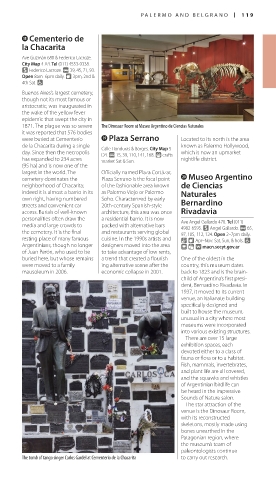
1871. The plague was so severe The Dinosaur Room at Museo Argentino de Ciencias Naturales
it was reported that 576 bodies
were buried at Cementerio o Plaza Serrano Located to its north is the area
de la Chacarita during a single Calle Honduras & Borges. City Map 5 known as Palermo Hollywood,
day. Since then the necropolis D4. @ 15, 39, 110, 141, 168. ( crafts which is now an upmarket
has expanded to 234 acres market Sat & Sun. nightlife district.
(95 ha) and is now one of the
largest in the world. The Officially named Plaza Cortázar,
cemetery domi nates the Plaza Serrano is the focal point p Museo Argentino
neigh borhood of Chacarita; of the fashionable area known de Ciencias
indeed it is almost a barrio in its as Palermo Viejo or Palermo Naturales
own right, having numbered Soho. Characterized by early Bernardino
streets and conve nient car 20th-century Spanish-style
access. Burials of well-known architecture, this area was once Rivadavia
personalities often draw the a residential barrio. It is now Ave Angel Gallardo 470. Tel (011)
media and large crowds to packed with alternative bars 4982-6595. Angel Gallardo. @ 65,
the cemetery. It is the final and restaurants serving global 97, 105, 112, 124. Open 2–7pm daily.
resting place of many famous cuisine. In the 1990s artists and & 8 Apr–Nov: Sat, Sun, & hols. 7
Argentinians, though no longer designers moved into the area - = ∑ macn.secyt.gov.ar
of Juan Perón, who used to be to take advantage of low rents,
buried here, but whose remains a trend that created a flourish- One of the oldest in the
were moved to a family ing alternative scene after the country, this museum dates
mausoleum in 2006. eco nomic collapse in 2001. back to 1823 and is the brain-
child of Argentina’s first presi-
dent, Bernardino Rivadavia. In
1937, it moved to its current
venue, an Italianate building
specifically designed and
built to house the museum,
unusual in a city where most
museums were incorporated
into various existing structures.
There are over 15 large
exhibition spaces, each
devoted either to a class of
fauna or flora or to a habitat.
Fish, mammals, invertebrates,
and plant life are all covered,
and the squawks and whistles
of Argentinian birdlife can
be heard in the impressive
Sounds of Nature salon.
The star attraction of the
venue is the Dinosaur Room,
with its reconstructed
skele tons, mostly made using
bones unearthed in the
Patagonian region, where
the museum’s team of
paleontolo gists conti nue
The tomb of tango singer Carlos Gardel at Cementerio de la Chacarita to carry out research.
118-119_EW_Argentina.indd 119 05/08/16 10:40 am

