


Page 159 - (DK Eyewitness) Travel Guide - Argentina
P. 159
THE P A MP AS 157
riders, as well as casual week-
enders. The area is also pop ular
with nature lovers as it supports
a large variety of wildlife, which
includes foxes, pumas, guanaco,
armadillos, and the copper
iguana. There are three small
villages from which to access
the range: Tornquist, Villa Ventana,
and Sierra de la Ventana. They are
all quiet, laid-back places, but
the last has a greater range of
services for tourists, as well as a
choice of several small hotels.
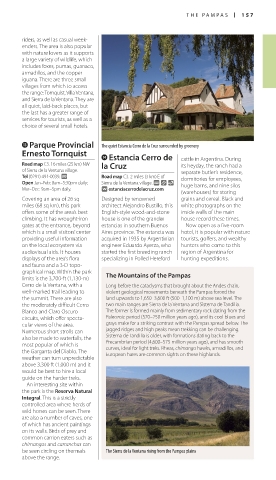
e Parque Provincial The quiet Estancia Cerro de la Cruz surrounded by greenery
Ernesto Tornquist
r Estancia Cerro de cattle in Argentina. During
Road map C3. 16 miles (25 km) NW la Cruz its heyday, the ranch had a
of Sierra de la Ventana village. separate butler’s resi dence,
Tel (0291) 491-0039. @ Road map C3. 2 miles (3 km) E of dormitories for employ ees,
Open Jan–Feb: 8am–5:30pm daily; Sierra de la Ventana village. @ 0 ® huge barns, and nine silos
Mar–Dec: 9am–5pm daily. ∑ estanciacerrodelacruz.com
(warehouses) for storing
Covering an area of 26 sq Designed by renowned grains and cereal. Black and
miles (68 sq km), this park architect Alejandro Bustillo, this white photographs on the
offers some of the area’s best English-style wood-and-stone inside walls of the main
climbing. It has wrought-iron house is one of the grander house record these times.
gates at the entrance, beyond estancias in southern Buenos Now open as a five-room
which is a small visitors’ center Aires province. The estancia was hotel, it is popular with nature
pro viding useful information acquired in 1935 by Argentinian tourists, golfers, and wealthy
on the local ecosystem via engineer Eduardo Ayerza, who hunters who come to this
audiovisual aids. It houses started the first breeding ranch region of Argentina for
displays of the area’s flora specializing in Polled Hereford hunting expeditions.
and fauna and a 3-D topo-
graphical map. Within the park The Mountains of the Pampas
limits is the 3,700-ft (1,130-m)
Cerro de la Ventana, with a Long before the cataclysms that brought about the Andes chain,
well-marked trail leading to violent geological movements beneath the Pampas forced the
the summit. There are also land upwards to 1,650–3,600 ft (500–1,100 m) above sea level. The
the moderately difficult Cerro two main ranges are Sierra de la Ventana and Sistema de Tandilia.
Blanco and Claro Oscuro The former is formed mainly from sedimentary rock dating from the
circuits, which offer specta- Paleozoic period (570–250 million years ago), and its cool blues and
cular views of the area. grays make for a striking contrast with the Pampas spread below. The
Numerous short strolls can jagged ridges and high peaks mean trekking can be challenging.
also be made to waterfalls, the Sistema de Tandilia is older, with formations dating back to the
Precambrian period (4,600–575 million years ago), and has smooth
most popular of which is curves, ideal for light treks. Rheas, chimango hawks, armadillos, and
the Garganta del Diablo. The European hares are common sights on these highlands.
weather can turn unpre dictable
above 3,300 ft (1,000 m) and it
would be best to hire a local
guide on the harder treks.
An interesting site within
the park is the Reserva Natural
Integral. This is a strictly
controlled area where herds of
wild horses can be seen. There
are also a number of caves, one
of which has ancient paintings
on its walls. Birds of prey and
common carrion eaters such as
chimangos and carranchas can
be seen circling on thermals The Sierra de la Ventana rising from the Pampas plains
above the range.
156-157_EW_Argentina.indd 157 05/08/16 10:41 am

