


Page 161 - (DK Eyewitness) Travel Guide - Argentina
P. 161
THE P A MP AS 159
artifacts is limited, but there are
fine examples of Patagonian
fauna and some dinosaur fossils
that were discovered when the
town center was redeveloped
in 1994. Santa Rosa is also the
base from which to explore
the impressive Parque Nacional
Lihué Calel.
Environs
Around 23 miles (35 km)
south of Santa Rosa is Reserva
Provincial Parque Luro. A
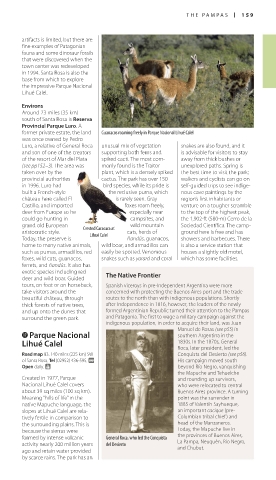
former private estate, the land Guanacos roaming freely in Parque Nacional Lihué Calel
was once owned by Pedro
Luro, a relative of General Roca unusual mix of vegetation snakes are also found, and it
and son of one of the creators supporting both ferns and is advisable for visitors to stay
of the resort of Mar del Plata spiked cacti. The most com- away from thick bushes or
(see pp152–3). The area was monly found is the Traitor unexplored paths. Spring is
taken over by the plant, which is a densely spiked the best time to visit the park;
provincial authori ties cactus. The park has over 150 walkers and cyclists can go on
in 1996. Luro had bird species, while its pride is self-guided trips to see indige-
built a French-style the reclusive puma, which nous cave paintings by the
château here called El is rarely seen. Gray region’s first inhabitants or
Castillo, and imported foxes roam freely, venture on a tougher scramble
deer from Europe so he especially near to the top of the highest peak,
could go hunting in camp sites, and the 1,902-ft (580-m) Cerro de la
grand old European Crested Caracara at wild moun tain Sociedad Científica. The camp-
aristocratic style. Lihué Calel cats, herds of ground here is free and has
Today, the preserve is ñandús, guanacos, show ers and barbecues. There
home to many native animals, wild boar, and armadillos can is also a service station that
such as pumas, armadillos, red easily be spot ted. Venomous houses a slightly old motel,
foxes, wild cats, guanacos, snakes such as yarará and coral which has some facilities.
ferrets, and ñandús. It also has
exotic species including red The Native Frontier
deer and wild boar. Guided
tours, on foot or on horseback, Spanish viceroys in pre-Independent Argentina were more
take visitors around the concerned with protecting the Buenos Aires port and the trade
beautiful château, through routes to the north than with indigenous populations. Shortly
thick forests of native trees, after Independence in 1816, however, the leaders of the newly
and up onto the dunes that formed Argentinian Republic turned their atten tion to the Pampas
surround the green park. and Patagonia. The first to wage a mili tary campaign against the
indigenous popu lation, in order to acquire their land, was Juan
Manuel de Rosas (see p55) in
u Parque Nacional southern Argentina in the
Lihué Calel 1830s. In the 1870s, General
Roca, later presi dent, led the
Road map B3. 140 miles (225 km) SW Conquista del Desierto (see p56).
of Santa Rosa. Tel (02952) 436-595. @ His campaign moved south
Open daily. beyond Río Negro, vanquishing
the Mapuche and Tehuelche
Created in 1977, Parque and rounding up survivors,
Nacional Lihué Calel covers who were reloca ted to central
about 39 sq miles (100 sq km). Buenos Aires province. A turning
Meaning “hills of life” in the point was the surren der in
native Mapuche language, the 1885 of Valentín Sayhueque,
slopes at Lihué Calel are rela- an important cacique (pre-
tively fertile in comparison to Columbian tribal chief) and
the surround ing plains. This is head of the Manzaneros.
because the sierras were Today, the Mapuche live in
formed by intense volcanic General Roca, who led the Conquista the provinces of Buenos Aires,
activity nearly 200 million years del Desierto La Pampa, Neuquén, Río Negro,
and Chubut.
ago and retain water provided
by scarce rains. The park has an
158-159_EW_Argentina.indd 159 05/08/16 10:41 am

