


Page 172 - (DK Eyewitness) Travel Guide - Argentina
P. 172
170 ARGENTINA REGION B Y REGION
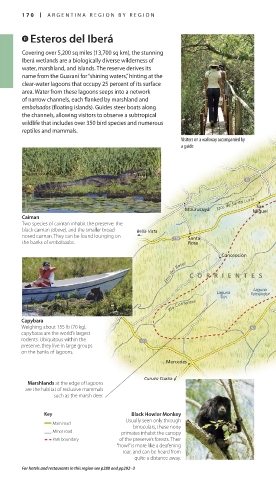
q Esteros del Iberá
Covering over 5,200 sq miles (13,700 sq km), the stunning
Iberá wetlands are a biologically diverse wilderness of
water, marshland, and islands. The reserve derives its
name from the Guaraní for “shining waters,” hinting at the
clear-water lagoons that occupy 25 per cent of its surface
area. Water from these lagoons seeps into a network
of narrow channels, each flanked by marshland and
embalsados (floating islands). Guides steer boats along
the channels, allowing visitors to observe a subtropical
wildlife that includes over 350 bird species and numerous Corrientes
reptiles and mammals.
Visitors on a walkway accompanied by
a guide Barranqueras Río Paraná
Posadas
Ituzaingó
Estero Carambola
Loreto
Eros de Santa Lucía
San
Mburucuyá Miguel
Caiman
Two species of caiman inhabit the preserve: the
black caiman (above), and the smaller broad- Bella Vista Laguna de Galarza
Luna
nosed caiman. They can be found lounging on Santa
the banks of embalsados. Rosa Río Aguapey
Concepción
Eros del Batel CORRIENTES Estancia Laguna
Iberá
Rincón del
Socorro Colonia Carlos
Laguna
Laguna Fernández Pellegrini
Trin
Río Corrientes
Capybara
Weighing about 155 lb (70 kg),
capybaras are the world’s largest Eros del Miriñay
rodents. Ubiquitous within the
preserve, they live in large groups
on the banks of lagoons.
Mercedes
Curuzú Cuatia
Marshlands at the edge of lagoons
are the habitat of reclusive mammals
such as the marsh deer.
Key Black Howler Monkey
Usually seen only through
Main road
binoculars, these noisy
Minor road primates inhabit the canopy
Park boundary of the preserve’s forests. Their
“howl” is more like a deafening
roar, and can be heard from
quite a distance away.
For hotels and restaurants in this region see p280 and pp292–3
170-171_EW_Argentina.indd 170 05/08/16 10:41 am
Eyewitness Travel LAYERS PRINTED:
Starsight template “UK” LAYER
(Source v2.7)
Date 24th April 2013
Size 125mm x 217mm

