


Page 261 - (DK Eyewitness) Travel Guide - Argentina
P. 261
P A T A GONIA 259
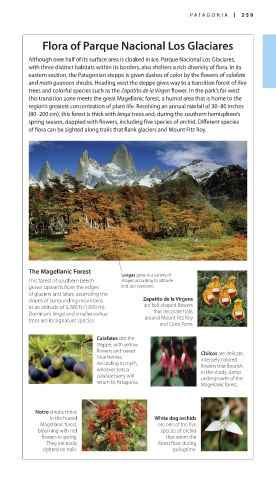
Flora of Parque Nacional Los Glaciares
Although over half of its surface area is cloaked in ice, Parque Nacional Los Glaciares,
with three distinct habitats within its borders, also shelters a rich diversity of flora. In its
eastern section, the Patagonian steppe is given dashes of color by the flowers of calafate
and mata guanaco shrubs. Heading west the steppe gives way to a transi tion forest of ñire
trees and colorful species such as the Zapatito de la Virgen flower. In the park’s far west
this transition zone meets the great Magellanic forest, a humid area that is home to the
region’s greatest concentration of plant life. Receiving an annual rainfall of 30–80 inches
(80–200 cm), this forest is thick with lenga trees and, during the southern hemi sphere’s
spring season, dappled with flowers, including five species of orchid. Different species
of flora can be sighted along trails that flank glaciers and Mount Fitz Roy.
The Magellanic Forest
Lengas grow in a variety of
This forest of southern beech shapes according to altitude
grows upwards from the edges and sun exposure.
of glaciers and lakes, ascending the
slopes of surrounding mountains Zapatito de la Virgens
to an altitude of 3,280 ft (1,000 m). are bell-shaped flowers
Dominant lenga and smaller coihue that decorate trails
trees are its signature species. around Mount Fitz Roy
and Cerro Torre.
Calafates dot the
steppe, with yellow
flowers and sweet Chilcos are delicate,
blue berries. intensely colored
According to myth, flowers that flourish
whoever eats a in the shady, damp
calafate berry will undergrowth of the
return to Patagonia. Magellanic forest.
Notro shrubs thrive
in the humid White dog orchids
Magellanic forest, are one of the five
blooming with red species of orchid
flowers in spring. that adorn the
They are easily forest floor during
sighted on trails. springtime.
258-259_EW_Argentina.indd 259 05/08/16 10:42 am

