


Page 89 - (DK Eyewitness) Travel Guide - Argentina
P. 89
SAN TELMO AND LA BOC A 87
Maradona and other soccer
stars, church leaders, and
even Buenos Aires waiters.
These elements are thrown
into the dramaturgical melting
pot to create works that are
witty and wild but which
also function as serious
historical commentaries.
Some shows are performed
outdoors, using the amphi-
theater at Parque Lezama, but
the company’s headquarters
remains at this converted
warehouse, where most of
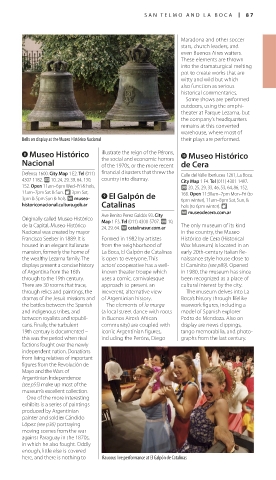
Bells on display at the Museo Histórico Nacional their plays are performed.
8 Museo Histórico illustrate the reign of the Pérons, 0 Museo Histórico
Nacional the social and eco nomic horrors de Cera
of the 1970s, or the more recent
Defensa 1600. City Map 1 E2. Tel (011) financial disasters that threw the Calle del Valle Iberlucea 1261, La Boca.
4307-1182. @ 10, 24, 29, 39, 64, 130, country into disarray. City Map 1 F4. Tel (011) 4301-1497.
152. Open 11am–6pm Wed–Fri & hols, @ 20, 25, 29, 33, 46, 53, 64, 86, 152,
11am–7pm Sat & Sun. 8 3pm Sat, 168. Open 11:30am–7pm Mon–Fri (to
3pm & 5pm Sun & hols. ∑ museo 9 El Galpón de 6pm winter), 11am–8pm Sat, Sun, &
historiconacional.cultura.gob.ar Catalinas hols (to 6pm winter). 8
∑ museodecera.com.ar
Ave Benito Perez Galdós 93. City
Originally called Museo Histórico Map 1 F3. Tel (011) 4300-5707. @ 10,
de la Capital, Museo Histórico 24, 29, 64. ∑ catalinasur.com.ar The only museum of its kind
Nacional was created by mayor in the country, the Museo
Francisco Seeber in 1889. It is Formed in 1982 by artistes Histórico de Cera (Historical
housed in an elegant Italianate from the neighborhood of Wax Museum) is located in an
man sion, formerly the home of La Boca, El Galpón de Catalinas early 20th-century Italian Re-
the wealthy Lezama family. The is open to everyone. This naissance style house close to
displays present a concise history actors’ cooperative has a well- El Caminito (see p89). Opened
of Argentina from the 16th known theater troupe which in 1980, the museum has since
through to the 19th century. uses a comic, carni valesque been recognized as a place of
There are 30 rooms that trace, approach to present an cultural interest by the city.
through relics and paintings, the irreverent, alternative view The museum delves into La
dramas of the Jesuit missions and of Argentinian history. Boca’s history through lifelike
the battles between the Spanish The elements of la murga waxwork figures, including a
and indi genous tribes, and (a local street dance with roots model of Spanish explorer
between royalists and republi- in Buenos Aires’s African Pedro de Mendoza. Also on
cans. Finally, the turbulent community) are coupled with display are news clippings,
19th century is documented – iconic Argentinian figures, tango memorabilia, and photo-
this was the period when rival including the Peróns, Diego graphs from the last century.
factions fought over the newly
independent nation. Donations
from living rela tives of important
figures from the Revolución de
Mayo and the Wars of
Argentinian Independence
(see p55) make up most of the
museum’s excellent collection.
One of the more interesting
exhibits is a series of paint ings
produced by Argentinian
painter and soldier Cándido
López (see p36) portraying
moving scenes from the war
against Paraguay in the 1870s,
in which he also fought. Oddly
enough, little else is covered
here, and there is nothing to Raucous live performance at El Galpón de Catalinas
086-087_EW_Argentina.indd 87 07/10/2016 16:55

