


Page 35 - All About History - Issue 72-18
P. 35
Elizabeth vs Mary


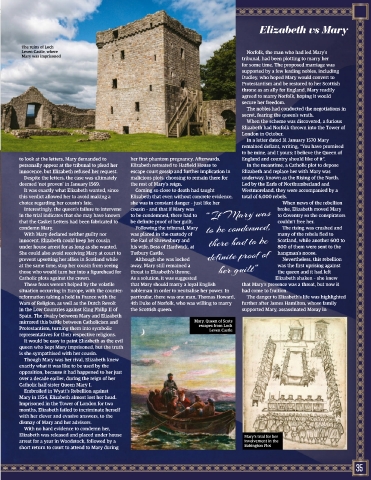
           The ruins of Loch
           Leven Castle, where                                                                                         Norfolk, the man who had led Mary’s
           Mary was imprisoned
                                                                                                                     tribunal, had been plotting to marry her
                                                                                                                     for some time. The proposed marriage was
                                                                                                                     supported by a few leading nobles, including
                                                                                                                     Dudley, who hoped Mary would convert to
                                                                                                                     Protestantism and be restored to her Scottish
                                                                                                                     throne as an ally for England. Mary readily
                                                                                                                     agreed to marry Norfolk, hoping it would
                                                                                                                     secure her freedom.
                                                                                                                       The nobles had conducted the negotiations in
                                                                                                                     secret, fearing the queen’s wrath.
                                                                                                                       When the scheme was discovered, a furious
                                                                                                                     Elizabeth had Norfolk thrown into the Tower of
                                                                                                                     London in October.
                                                                                                                       In a letter dated 31 January 1570 Mary
                                                                                                                     remained defiant, writing, “You have promised
                                                                                                                     to be mine, and I yours; I believe the Queen of
          to look at the letters, Mary demanded to              her first phantom pregnancy. Afterwards,             England and country should like of it”.
          personally appear at the tribunal to plead her        Elizabeth retreated to Hatfield House to               In the meantime, a Catholic plot to depose
          innocence, but Elizabeth refused her request.         escape court gossip and further implication in       Elizabeth and replace her with Mary was
             Despite the letters, the case was ultimately       malicious plots, choosing to remain there for        underway, known as the Rising of the North.
          deemed ‘not proven’ in January 1569.                  therestofMary’sreign.                                Led by the Earls of Northumberland and
             It was exactly what Elizabeth wanted, since          Coming so close to death had taught                Westmoreland, they were accompanied by a
          this verdict allowed her to avoid making a            Elizabeth that even without concrete evidence,       totalof6,000 rebels.
          choice regarding her cousin’s fate.                   she was in constant danger – just like her                              When news of the rebellion
             Interestingly, the queen’s failure to intervene    cousin – and that if Mary was                                         broke, Elizabeth moved Mary
          inthetrialindicatesthatshemayhaveknown                to be condemned, there had to       “If Mary was                      to Coventry so the conspirators
          that the Casket Letters had been fabricated to        be definite proof of her guilt.                                       couldn’t free her.
                                                                                                    to be condemned,
          condemn Mary.                                           Following the tribunal, Mary                                          The rising was crushed and
             With Mary declared neither guilty nor              was placed in the custody of                                          many of the rebels fled to
          innocent,Elizabethcouldkeephercousin                  theEarlofShrewsburyand               there had to be                  Scotland, while another 600 to
          under house arrest for as long as she wanted.         his wife, Bess of Hardwick, at                                        800 of them were sent to the
          ShecouldalsoavoidreceivingMaryatcourtto               Tutbury Castle.                      GHúQLWH SURRI RI                 hangman’s noose.
          prevent upsetting her allies in Scotland while          Although she was locked                                               Nevertheless, this rebellion
          at the same time, stop her cousin from seeing         away, Mary still remained a                                           was the first uprising against
          those who would turn her into a figurehead for        threat to Elizabeth’s throne.             her guilt”                  the queen and it had left
          Catholic plots against the crown.                     As a solution, it was suggested                                      Elizabeth shaken – she knew
             These fears weren’t helped by the volatile         that Mary should marry a loyal English               that Mary’s presence was a threat, but now it
          situation occurring in Europe, with the counter-      nobleman in order to neutralise her power. In        had come to fruition.
          reformation taking a hold in France with the          particular, there was one man, Thomas Howard,          The danger to Elizabeth’s life was highlighted
          Wars of Religion, as well as the Dutch Revolt         4th Duke of Norfolk, who was willing to marry        further after James Hamilton, whose family
          in the Low Countries against King Philip II of        the Scottish queen.                                  supported Mary, assassinated Moray in
          Spain. The rivalry between Mary and Elizabeth
          mirrored this battle between Catholicism and                                        Mary, Queen of Scots
                                                                                                escapes from Loch
          Protestantism, turning them into symbolic
                                                                                                     Leven Castle
          representatives for their respective religions.
             It would be easy to paint Elizabeth as the evil
          queen who kept Mary imprisoned, but the truth
          is she sympathised with her cousin.
             Though Mary was her rival, Elizabeth knew
          exactly what it was like to be used by the
          opposition, because it had happened to her just
          over a decade earlier, during the reign of her
          Catholic half-sister Queen Mary I.
             Embroiled in Wyatt’s Rebellion against
          Mary in 1554, Elizabeth almost lost her head.
          Imprisoned in the Tower of London for two
          months, Elizabeth failed to incriminate herself
          with her clever and evasive answers, to the
          dismay of Mary and her advisors.
             With no hard evidence to condemn her,
          Elizabeth was released and placed under house                                                               Mary’s trial for her
          arrest for a year in Woodstock, followed by a                                                               involvement in the
                                                                                                                      Babington Plot
          short return to court to attend to Mary during


                                                                                                                                                                            35

