


Page 37 - All About History - Issue 72-18
P. 37
try Mary and potentially put her to death if she
          plotted against Elizabeth.
             It allowed Elizabeth and her government
          to remove Mary from the line of succession,
          although the queen specified that the act
          shouldn’t exclude the heirs of those found
          guilty of treason, unless they were also
          involved. Elizabeth was clearly thinking about
          King James VI and the future of the English
          succession when she included this caveat.
          However she wasn’t the only one thinking
          about James, as Mary had to reach out to her
          son for help in negotiating her freedom. Sadly,
          Mary’s hope was in vain.
             In her absence, James had been raised to
          believe that she was an adulterer who deserved
          to lose the crown and now that he was King of
          Scots, he had no desire to see her return home.
             Mary was crushed by her son’s rejection and
          to twist the knife further, James forged a new
          Anglo-Scottish alliance with Elizabeth, signing
          the Treaty of Berwick on the 6 July 1586. After
          almost two decades of captivity, abandoned by
          James and resigned to the fact Elizabeth would
          never help her, Mary was forced to accept any
          support that came her way.


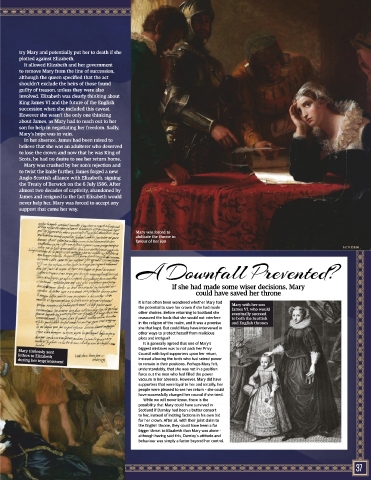
                                                                  Mary was forced to
                                                                  abdicate the throne in
                                                                  favour of her son


                                                                  A Downfall Prevented?


                                                                                   If she had made some wiser decisions, Mary
                                                                                               could have saved her throne

                                                                   It is has often been wondered whether Mary had
                                                                                                                Mary with her son
                                                                   the potential to save her crown if she had made
                                                                                                                James VI, who would
                                                                   other choices. Before returning to Scotland she   eventually succeed
                                                                   reassuredthelordsthatshe would not interfere   to both the Scottish
                                                                   in the religion of the realm, and it was a promise   and English thrones
                                                                   she that kept. But could Mary have intervened in
                                                                   other ways to protect herself from malicious
                                                                   plots and intrigue?
                                                                      It is generally agreed that one of Mary’s
                                                                   biggestmistakeswastonot pack her Privy
          Mary tirelessly sent
                                                                   Council with loyal supporters upon her return,
          letters to Elizabeth
                                                                   instead allowing the lords who had seized power
          during her imprisonment
                                                                   to remain in their positions. Perhaps Mary felt,
                                                                   understandably, that she was not in a position
                                                                   force out the men who had filled the power
                                                                   vacuum in her absence. However, Mary did have
                                                                   supporters that were loyal to her and initially, her
                                                                   people were pleased to see her return – she could
                                                                   have successfully changed her council if she tried.
                                                                      While we will never know, there is the
                                                                   possibility that Mary could have survived in
                                                                   Scotland if Darnley had been a better consort
                                                                   to her, instead of inciting factions in his own bid
                                                                   for her crown. After all, with their joint claim to
                                                                   the English throne, they could have been a far
                                                                   bigger threat to Elizabeth than Mary was alone –
                                                                   although having said this, Darnley’s attitude and
                                                                   behaviour was simply a factor beyond her control.


                                                                                                                                                                            37

