


Page 104 - DK Eyewitness Travel Guides - The World's Must-See Places
P. 104
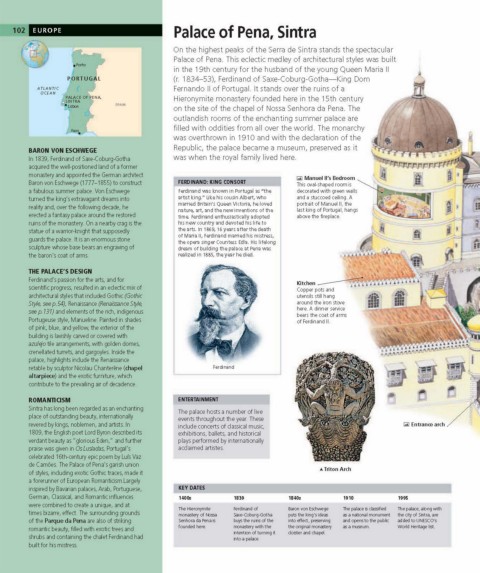
Palace of Pena, Sintra
     102  EUROPE

                                                     On the highest peaks of the Serra de Sintra stands the spectacular
                                                     Palace of Pena.  This eclectic medley of architectural styles w as built
                                                     in the 19th century for the husband of the young Queen Maria II
                     PORTUGA L                       (r.  1834- 53), Ferdinand of Saxe-Coburg-Gotha- King Dom
            ATLANTIC                                 Fernando II of Portugal. It stands over the ruins of a
             OCEAN
                     PAlACE OF PENA.
                    SINTRA                           Hieronymite monastery founded here in the 15th century
                                   SPAIN
                    •  Usllon                        on the site of the chapel of Nossa Senhora da Pena.  The
                                                     outlandish rooms of the enchanting summer palace are
                                                     filled with oddities from all over the world. The monarchy
                                                     was overthrown in  1910 and w ith the declaration of the
                                                     Republic, the palace became a museum, preserved as  it
         BARON VON ESCHWEGE
         In 1839, Ferdinand of Saxe-Coburg-Gotha     was when the royal family lived  here.
         acquired the well-positioned land of a  former
         monastery and appointed the German architect
                                                                                         !;il Manuelll's Bedroom
         Baron von Eschwege (1777- 1855) to construct   FERDINAND: KING  CONSORT         This oval-shaped room is
         a fabulous  summer palace. Von Eschwege      Ferdinand was known in Portugal as "the   decorated with green walls
         turned the king's extravagant dreams into    artist king." Uke his cousin Albert, who   and a stuccoed ceiling. A
                                                      married Britain's Queen Victoria, he loved   portrait of Manuel II, the
         reality and, over the following decade, he
                                                      nature, art, and the new inventions of the   last king of Portugal, hangs
         erected a  fantasy palace around the restored   time.  Ferdinand enthusiastically adopted   above the fireplace.
         ruins of the  monastery  On a  nearby crag is the   his new country and devoted his  li fe to
         statue of a  warrior-knight that supposedly   the arts. In 1869, 16 years  a  tter the death
                                                      of Maria II, Ferdinand married his mistress,
         guards the palace. It IS an enormous stone
                                                      the opera singer Countess Edla. His lifelong
         sculpture whose base bears an engraving of   dream of building the palace at Pena was
         the baron's coat of arms                     realized in 1885,  the year he died.
         THE  PALACE'S DESIGN
         Ferdinand's pasSion for the arts, and for                                                                        1
                                                                                                              ,  , • • • •  • • • '
                                                                                         Kitchen ~ •  •  •
          sdentffic progress, resuted 1n an edectic mix of
                                                                                         Copper pots and
          archltectiJal styles that 1nduded Gothic (Gothic                               utensils still hang
         Styfe, seep. 54),  Renassance (Renaissance Style,                                around the iron stove
                                                                                         here. A dinner service
         see p. 131) and elements of the rich, indigenous
                                                                                         bears the coat of arms
         Portugeuse style, M  anueli ne  Painted in shades                               of Ferdinand II.
         of pink, blue, and yellow, the exterior of the
         building is lavishly carved or covered \IIIith
         azuleyo  tile arrangements, with go  I  den domes,
         crenellated turrets, and gargoyles. Inside the
         pal ace, highlights include  the Renaissance
         retabl e by sculptor Nicolau C  hantere ne (chapel     Ferdinand
         altarpiece) and the exotic  furniture, which
         contribute to the prevailing air of decadence.

         ROMANllCISM                                  ENTERTAINMENT
         Si  ntra has long been regarded as an enchanting
                                                      The palace hosts a number of live
         place of outstanding beauty, internationally
                                                      events throughout the  year. These
         revered by kings, noblemen, and artists.  In   include concerts  of classical music,                            ~  Entrance arch
          1809, the Enghsh poet Lord Byron described its   exhibitions, ballets, and historical
         verdant beauty as "glonous Eden," and fJJther   plays  performed by internationally
         praise was giVen 1n OsLusiadas, Portugal's   acdaimed artistes.
         celebrated 16th-century epc poem by luis Vaz
         de Cam6es  The Palace of Pena's gansh urion
                                                                                                A Triton Arch
          of styles, indud1ng exotic GothiC traces, made it
          a  forerunner of EJJopean Romantldsm.largely
         impired by Bavanan palaces, Arab, Portuguese,   KEY DATES
         Germ an, Classical, and Rom antic mfluences   1400s           1839            1840s           1910             1995
         were combined to create a unique, and at
                                                      The Hieronymite   Ferdinand of   Baron von Eschwege   The palace i5 classified   The palace, ab ng  w1th
         times bizarre, effect. The surrounding grounds
                                                      monastel)' of Noosa   saxe-Coburg-Gotha   puts the klng's ideas   as a national monument   the city of S intra, are
         of the  Parque da Pen  a are also of striking   Senhora da Pen a is   buys the ruins of the   Into effect, preserving   and opens to the public   added to UNESCO's
         romantic  beauty, filled with exotic  trees and   founded here.   monastery with the   the original monastel)'   as a museum.   World Heritage list.
                                                                       intentiOn of turning It   cloister and chapel.
         shrubs and containing the cha let Ferdinand had               into a palace.
         built for his  mistress.

