


Page 106 - DK Eyewitness Travel Guides - The World's Must-See Places
P. 106
104


                  lAY OF  BISCAY
                                 FRAN<l
                 SANTIAGO  DE  •Bilbao..,
                 COMPOSTELA
                 'AT"'. E  ORAL
                                Barcelona•
                          .Madrid
              PORTUGAL
                       SPAIN

                                 MEDI7lRIIANEAN
                                     SEA
           ATLANTIC
            OCEMI                    AlGERIA


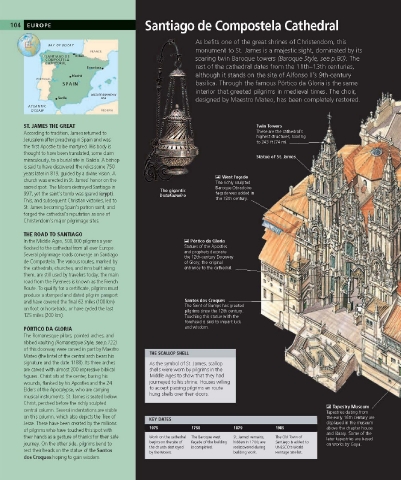
          ST. JAMES THE GREAT
         Accord1ng to tradition, James returned to
         Jerusalem after preaching in Spain and was
         the  first Apostle  to be martyred. His body is
         thought to have been translated, some  claim
         miraculously, to a  burial site in Galicia. A bishop
          is said to have discovered the rei ics some 7  50
         years later in 819, guided by a  divine vision.  A
          church was erected in St. James' honor on the
          sacred spot The Moors destroyed Santiago 1n
         997, yet the saint's tomb was spared (crypt)
          This, and subsequent Christian victories, led to
         St  James becoming Spain's  patron saint, and
         forged the cathedral's reputation as one of
         Christendom's major pilgrimage sites.


         THE ROAD TO SANTIAGO
         In the Middle  Ages,  500,000 pilgrims  a  year
         flocked to the cathedral from all over Europe
          Several pilgrimage roads converge on Santiago
          de Compostela. The various routes, marked by
         the cathedrals, churches, and inns built along
         them, are still used tlf travelers today; the mam
         road from the Pyrenees is known as the French
          Route. To qualify for a  certificate, pilgrims must
         produce a  stamped and dated pi  I  grim passport
         and have covered the final 62 miles (  1  00 km)
          on foot or hors eback, or have cycled the  last
          125 miles (200 km)

          PORTICO DA GLORIA
          The Romanesque pillars, pointed ,..ches, and
         ribbed vauting (Romanesque Style, see p.122)
         of th1s doorw<PJ were carved in part by Maestro
         Mateo (the lintel of the central arch bears his
         s1gnature and the date 1188)  Its three arches   As  the symbol of S t. James, scallop
         are carved with a lmost 200 express ive biblical   shells were worn by pilgrims in the
         figures. Christ s its  at the center, baring his   Middle Ages  to s how that the y had
         wounds, flanked by his Apostles and the  24   journeyed to his  shrine.  Hous es willing
         E lders of the Apocalypse, who are carrying   to accept pas sing pilgrims  en route
                                                      hung shells  over their doors.
          musical instruments. St. James is seated below
          Christ, perched before  the richly sculpted
          central column. Several indentations are viSible
         on ths  column, W'lich also depicts the Tree of
         Jesse. These have been created tlf the millions
         of pilgnms who have touched this spot wrth
         their hands as a  gesture of  thanks for their safe
         journey. On the other side, pilgrims  bend to
         rest their heads on the statue of the Santos
         dos  C roques  hoping to gain wisdom.

