


Page 112 - DK Eyewitness Travel Guides - The World's Must-See Places
P. 112
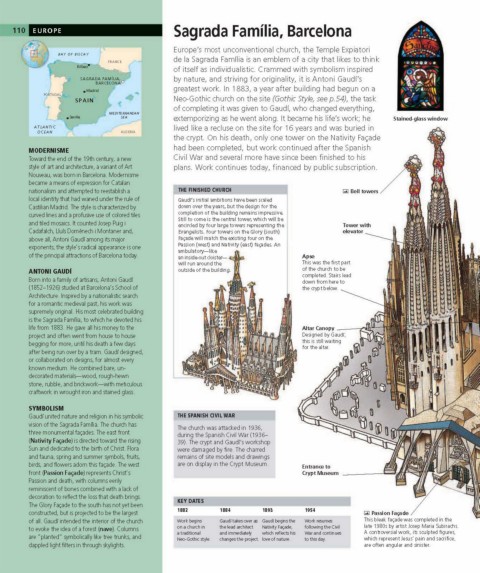
Sagrada Familia, Barcelona
     110  EUROPE


                                                     Europe's most unconventional church, the T emple E xpiatori
                                                     de Ia Sagrada  Famflia is an emblem of a city that likes to think
                                 FRAM<l
                                                     of itself as individualistic. Crammed with symbolism inspired
                         SAGRAOA FAMiliA.            by nature, and striving for originality,  it is Antoni Gaudf's
                             BARCElONA
                                                     greatest work. In  1883, a year after building had begun on a
                          eMadrtd
                       SPAIN                         Neo-Gothic church on the site (Gothic Style, see p.54 ), the task
                                                     of completing it was given to Gaudf, who changed everything,
                                 lti/EDITr RIIANEAN
                                     S£A             extemporizing as he went along. It became his life's work; he    Stained-glass window
           ATlANTIC                                  lived like a recluse on the site for 16 years and was  buried in
            OCEAN                    ALGERIA
                                                     the crypt.  On his death, only one tow er on the Nativity Fa<;ade
                                                     had been completed,  but w ork continued after the Spanish
         MODERNISME
          Toward the end o f the 19th century, a  new   Civil War and several more have since been finished  to his
         style of art and archrtecture, a  variant of Art   plans.  Work continues today, financed by public subscription.
         Nouveau, was born in Barcelona. Modernisme
         became  a  means  of expression for Catalan
         nationalism and attempted  to reestablish a   THE  FINISHED CHURCH                            ~Bell  towers
         I  ocal identity that had wa ned under the rule of   Gaudi's initial ambitions have been scaled
         Castilian Madrid. The  style  is  cha racterized by   down over the years, but the design tor the
         curved lines and a  profus ive use of colored  tiles   <Ompletion of the building remains  Impressive.
                                                      Still to come is the central tower, which will be
         and tiled mosaics. It counted J osep P ui g i   encircled by four large towers representing the   Tower with
         Cadafalch, Llufs  Dome nech i Montaner and,   Evangelists.  F our towers on the G lory (south)   elevator
         above  all, Anton Gaudi among rts major      Fa~ade  will match the existing four on the
         exponents; the style's radical appearance is one   Passion (west) and Nativity (east) fa~des. A.n
                                                      ambulatory- like
         of  the prinapal attracbons of  Barcelona tod"f.   an ins ide-out  cloister-      Apse
                                                      will run around the                  This was the first part
         ANTONI GAUD(                                 outside  of the  building.           of the church  to be
                                                                                           completed. Stairs lead
         Born into a  family of artisans, Antoni Gaudi                                     dcmn from here to
         (1852- 1926) studred at Barcelona's School of                                     the crypt belcm.
         Architecture. lnsprred by a  natronalistrc search
         for a  romantic medreval past, hrs work was
         supremely  original  Hrs most celebrated building
         is the Sagrada  F amilia, to which he  devoted his
         I  ife from  1883. He  gave a ll hr s  mone y  to the                             Altar Canopy  -----.z'"'lll~---t
         project and o ften went from house to house                                       Des i  gned by G  audi,
         begging for more, until his  death a  fe w days                                   this is still waiting
                                                                                           for the altar.
         after being run over by a  tram, G audi designed,
         or collaborated on designs , for almost every
         known medium. He  combined bare , un-
         decorated materials-wood, rough-he wn
         stone, rubble, and brickwork- with meticulous
         craftwork in wrought iron and stained glass.


         SYMBOLISM
         G  audi united nature  and religr  on in his  symbolic   THE SPANISH CIVIL WAR
         vision of the Sagrada Famflla. The church has   The church was attacked in 1936,
         three monumental fa~ades The east front      during the Spanis h Civil War (1936-
         (Nativity F~de) rs drrected toward the nsmg   39). The crypt and Gaudf's workshq:>
          Sun and dedicated to the brth of  Christ  Flora   were damaged by fire. T he charred
         and fauna, sprrng and summer symbols, frurts,   remains of site models  and drawings
         brrds, and flowers ad  om thrs fa~ade. The west   are on display in the Crypt Museum   Entran<e to
         front (,Passion f a!;<lde) represents Chrrst'  s                                  C rypt Museum
         Passion and death, wth columns eenly
         reminiscent of bones combined wrth a  lack of
         decoration to reflect the loss that death brings.
                                                      KEY DATES
          The Glory Fa<;ade  to  the  south has not yet been
                                                      1882         1884        1893         1954
         constructed, but is  projected to be  the  largest                                                  ~  Passion Fa~  de
         of all Gaudi intended the interior of the church   Work begins   Gaudi takes 011er as  Gaud  I begins the   Work resumes   This bleak fao;ade was completed in the
         to evoke the idea  of a  forest (nave). Columns   on a church in   the lead architect   Natlv~y  Fa;ade,   following the Civil   late 1980s by artist J osep Maria S ubirachs.
                                                      a traditional   and imrnedlateo/   which reflects his   \Mlr  and continues   A controversial work, its sculpted  figures,
         are "planted" symbolically like  tree trunks, and
                                                      Neo-Gothic style.   changes the project.  l011e of nature.   to this day.   which represent Jesus' pain and sacrifice,
         dappled light filters  in through s kylights.                                                        are often angular and  s inister.

