


Page 116 - DK Eyewitness Travel Guides - The World's Must-See Places
P. 116
The Alhambra, Granada
     114  EUROPE

                                                     A magical use of space,  light, water, and
                                 FRANCE.             decoration characterizes this most sensual
                                                     piece of Moorish architecture. The Islamic
                                Barcebna.            Moors first arrived in Spain  in 710.  By  the
                          •  Ma:irid                 late 13th century, only the Nasrid kingdom of
                       SPAIN                         Granada remained under their control, and the
                                  ME DITE fl.fi.ANEAN   Alhambra is  the most remarkable structure to
                                      SEA
                          THE  ALHAMBRA,
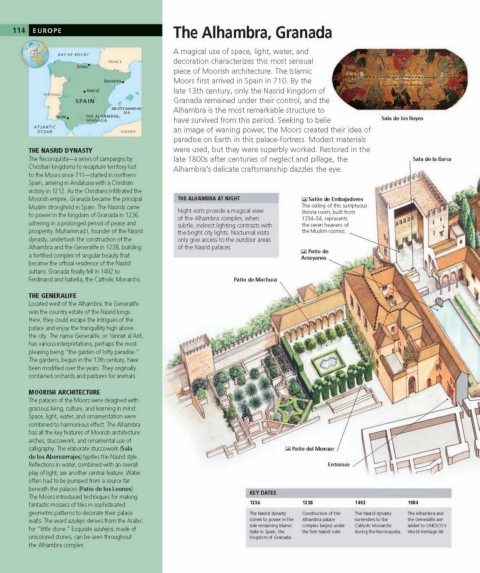
                          GRANADA                    have survived from this period. Seeking  to belie             Sala de los Reyes
           A TlA~'TIC
            OC£AII/                  ALGERIA         an  image of waning power, the Moors created  their idea of
                                                     paradise on Earth  in  this  palace-fortress.  Modest materials
         THE NASRID DYNASlY                          were used,  but they were superbly worked.  Restored  in  the
         The Reconquista-a series of campaigns by    late 1800s after centuries of neglect and  pillage,  the               Sala de Ia Bar <a
         Christian kingdoms to recapture territory lost   Alhambra's delicate craftsmanship dazzles the eye.
         to the Moors since 711-started in northern
         Spain, arriving in Andalusia with a Christian
         victory in 1212. As the Christians infiltrated the
         Moorish empire, Granada became the principal   THE ALHAMBRA AT NIGHT              ~ Salon de Embajadores
         Muslim stronghold in Spain. The Nasrids came                                      The ceiling of this sumptuous
                                                      Night visits provide a magical view   throne room, built from
         to power in the kingdom of Granada in 1236,
                                                      of the Alhambra complex, when        1334-54, represents
         ushering in a prolonged period of peace and   subtle, indirect lighting contrasts with   the seven heavens of
         prosperity .. Muhammad I, founder of the Nasrid   the bright city lights. Nocturnal visits   the Muslim cosmos.
         dynasty, undertook the construction of the   only give access to the outdoor areas
         Alhambra and the Generalife in 1238, building   of the Nasrid palaces.
                                                                                           ~ Patio de
         a fortified complex of singular beauty that                                       Arrayanes
         became the official residence of the Nasrid
         sultans. Granada finally fell in 1492 to
         Ferdinand and Isabell a, the Catholic Monarchs.               Patio de Machuca

         THE GENERALIFE
         Located west of the Alhambra, the Generalife
         was the country estate of the Nasrid kings.
         Here, they could escape the intrigues of the
         pal ace and enjoy the tranquil! ity high above
         the city. The name Generalife, or Yannat al Arif,
         has various interpretations, perhaps the most
         pleasing being "the garden of lofty paradise."
          The gardens, begun in the 13th century, have
         been modified over the years. They originally
         contained orchards and pastures for animals.

         MOORISH ARCHITECTURE
          The palaces of the Moors were designed with
         gracious living, culture, and learning in mind ..
         Space, light, water, and ornamentation were
         combined to harmonious effect. The Alhambra
         has all the key features of Moorish architecture
         arches, stuccowork, and ornamental use of
         calligraphy. The elaborate stuccowork (Sala                                  ~ Patio del Mexuar
         de los Abencerrajes) typifies the Nasrid style.
         Reflections in water, combined with an overall                                            Entrance
         play of light, are another central feature. Water
         often had to be pumped from a source far
         beneath the palaces (Patio de los Leones)
                                                                           KEY DATES
          The Moors introduced techniques for making
         fantastic mosaics of tiles in sophisticated                       1236            1238            1492            1984
         geometric patterns to decorate their pal ace                      lhe 1\asrid dynasty   Construction of the   The 1\asrid dynasty   lhe Alhambra and
         walls. The word azulejo derives from the Arabic                   comes to power in the   Alhambra palace   surrenders to the   the Genera life are
                                                                           sole remaining Islamic   complex begins under   Catholic Monarchs   added to UNESCO's
         for "little stone." Exquisite azu/ejos, made of
                                                                           state in Spain, the   the first Nasrid ruler.   during the Reconquista.   \1\brld Heritage list.
         unicolored stones, can be seen throughout                         Kingdom of Granada.
         the Alhambra complex.

