Page 139 - DK Eyewitness Travel Guides - The World's Must-See Places
P. 139
GREECE  137


          LOCATOR MAP                                           THE ELGIN MARBLES
                                                                                                             )r ~ B~RIA  ""'
                                                                                                             ,."':.lDON.I-::-__:r.~r I
                                                                Lord Elgin acquired architectural
                                                                                                          ALBAN~   eThessaloniki
                                                                features from the Parthenon in
                                                                1801-5 and sold them  to Britain.
                                                                                                                       A£G£AN
            ~              ACROPOLIS                            Controversy surrounds these so-                      ..   SEA    TURKE.Y
            $
           ;;r  HiN of the                                      called  "Elgin Marbles," which are                    ACROPOLI S,
           .;:;:   Nymphs       Akropoli                                                                             0
           :;                                                   now in London's British Museum, as                    ATHENS
                                                                some believe they belong in Athens.
                                                                                                       MEDITERRAII/EAII/
                                                                                                            SEA
          KEY
          Iii Area illustrated bebw
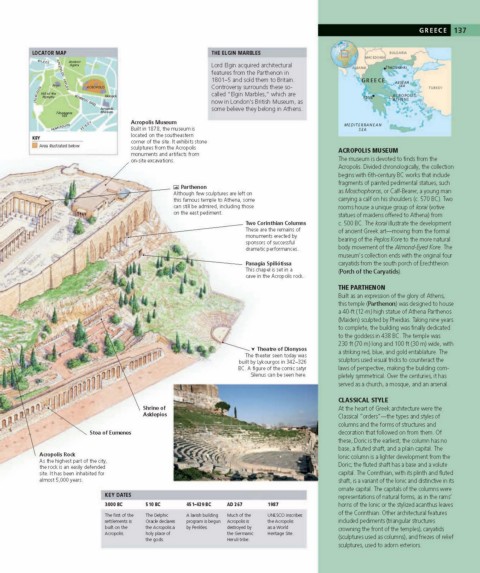
                                                                                                      ACROPOLIS MUSEUM
                                                                                                      The museum is devoted to finds from the
                                                                                                      Acropolis. Divided chronologically, the collection
                                                                                                      begins with 6th-century BC works that include
                                                                                                      fragments of painted pedimental statues, such
                                                  _   ~ Parthenon
                                 ~~----::.t-'"~?---  Although few sculptures are left on              as Moschophcros, or Calf-Bearer, a young man
                                                     th1s  famous temple to Athena, some              carrying a calf on his shoulders (c 570 BC)  Two
                                                     can snll be admred, 1nclud1ng those              rooms house a unique group of kDrai (votive
                                                     on the east pediment
                                                                                                      statues of maidens offered to Athena) from
                                       ~ ~J~~Pi.~---------- Two Corinthian Columns                    c  500 BC. The korai illustrate the development
                                                                          These are the remains of
                                                                                                      of ancient Greek art-moving from the formal
                                                                          monuments erected by
                                                                          sponsors of successful      bearing of the Pep!os Kore to the more natural
                                                                          dramatic performances.      body movement of the Almond-Eyed Kore.  The
                                                                                                      museum's collection ends with the original four
                                                                          Panagia Spili6tissa         caryatids from the south porch of Erechtheion
                                                                          This chapel is set in a     (Porch of the Caryatids).
                                                                          cave in the Acropolis rock.
                                                                                                      THE PARTHENON
                                                                                                      Bui It as an expression of the glory of Athens,
                                                                                                      this temple (Parthenon) was designed to house
                                                                                                      a 40-ft (12-m) high statue of Athena Parthenos
                                                                                                      (Maiden) sculpted by Pheidias. Taking nine years
                                                                                                      to complete, the building was finally dedicated
                                                                                                      to the goddess in 4 38 BC. The tempi e was
                                                                                                      230 ft (70 m) long and 100ft (30m) wide, with
                                                                   ~ ¥  Theatre of Dionysos           a striking red, blue, and gold entablature. The
                                                                          The  theater seen today was
                                                                        built by Lykourgos in 342-326   sculptors used visual tricks to counteract the
                                                                        BC. A figure of the comic satyr   laws of perspective, making the building com-
                                                                            Silenus can be seen here.   pletely symmetrical Over the centuries, it has
                                                                                                      served as a church, a mosque, and an arsenal.

                                                                                                      CLASSICAL STYLE
                                                                                                      At the heart of Greek architecture were the
                                                                                                      Classical  "orders" -the types and styles of
                                                                                                      columns and the forms of structures and
                                                                                                      decor at ion that foil owed on from them .. Of
                                                                                                      these, Doric is the earliest; the column has no
                                                                                                      base, a fluted shaft, and a pi ai n capital The
             Acropolis Rock                                                                           Ionic column is a lighter development from the
             As  the highest part of the city,
             the rock is an  easily defended                                                          Doric; the fluted shaft has a base and a volute
             site. It has been inhabited for                                                          capital. The Corinthian, with its plinth and fluted
             almost 5,000 years.                                                                      shaft, is a variant of the Ionic and distinctive in its
                                                                                                      ornate capital. The capitals of the columns were
                                KEY DATES                                                             representations of natural forms, as in the rams'
                                3000 BC     510 BC      451-429 BC   AD 267      1987                 horns of the Ionic or the stylized acanthus leaves
                                                                                                      of the Corinthian. Other architectural features
                                The first of the   The Delphic   A lavish building   Much of the   UNESCO inscribes
                                settlements is   Oracle declares   program is begun   Acropolis is   the Acropolis   included pediments (triangular structures
                                built on the   the Acropolis a   by Perikles.   destroyed by   as a World   crowning the front of the tern pies), caryatids
                                Acropolis.   holy place of           the Germanic   Heritage Site.
                                            the gods.                Heruli tribe.                    (sculptures used as columns), and friezes of relief
                                                                                                      sculptures, used to adorn exteriors.
   134   135   136   137   138   139   140   141   142   143   144