


Page 142 - DK Eyewitness Travel Guides - The World's Must-See Places
P. 142
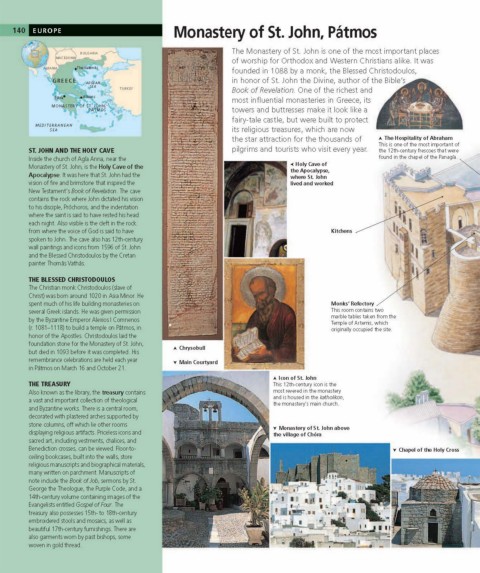
Monastery of St. John, Patmos
     140  EUROPE

                                                                      The Monastery of St.  John is one of the most important places
                                                                      of worship for Orthodox and Western Christians alike.  It was
                                                                      founded in  1  088 by a monk,  the Blessed Christodoulos,
                 GREEC E   :O£G£AM                                    in honor of St. John the Divine, author of the Bible's
                            SEA
                                     TURKlV
                                                                      Book of Revelation.  One of  the richest and
                 Pat~•   ,.Athens
                                                                      most influential monasteries  in Greece,  its
                MONASTER Y OF  ST.' JOHN~
                           PATMOS                                     towers and buttresses make it look like a
                                                                      fairy-tale castle, but were built to protect
           MEDITERRANEAN
                SEA                                                   its religious treasures, which are now
                                                                      the star attraction for the thousands of    A  The Hos pitality of Abraham
                                                                                                                  This is one of the most important of
         ST. JOHN AND THE HOLY CAVE                                   pilgrims and  tourists who visit every year.   the 12th-century frescoes that were
         Inside the church of Agia Anna, near the                                                                 found in the chapel of the Panagia.
                                                                                       -< Holy cave of
         Monastel)l of S tJohn, is the Holy Cave of the                                                                                   ~
                                                                                        the Apocalypse,
         Apocalypse. I t was here that StJohn had the
                                                                                       where St John
         vision of fire and brimstone that inspired the                                lived and worked
         N ew T estament's Book of  Revelatim. The cave
         contains the rock where John dictated his vision
         to his disciple, Pr6choros, and the indentation
         where the saint is said to have rested his head
         each nig"lt  Also visible is the deft in the rock
         from where the voice of God is said to have                                                Kitchens
         spoken to John. The cave also has 12th-century
         wall pa1ntings and icons from 1596 of St. John
         and the B lessed Christodoulos by the Cretan
         painter Thorn as  Vathas.


         THE BLESSED CHRISTODOULOS
          The Christian monk C  hristodoulos (slave of
         Christ) was born around  1020 in Asia M inor. H e
         spent much of his life building monastenes on                                              Monks' Refect ory
         se~~eral Greek islands. He was given permiSSIOn                                            This room contains two
                                                                                                    marble tables taken from the
         by the Byzantine Emperor Alexios I  C  omnenos
                                                                                                    Temple of  Arterris, which
         (r. 1081-1118) to build a temple on Patmos,  1n                                            originally occupied the site.
         honor of the Apostles. Christodoulos laid the
         foundation stone for the Monastery of St  John,
                                                     A  Chrysobull
         but died in  1093 before i t was completed. His
         remembrance celebrations are held each year
                                                     Y  Main Courtyard
         in P atmos on March  16 and October 21.
                                                                                  A  Icon of St. John
         THE TREASURY                                                             This 12th-century icon is the
         Also known as the library, the treasury contains                         most reuered in the monastery
                                                                                  and is  housed in the katholikon,
         a vast and 1mportant collection of theological
                                                                                  the monastery's main church.
         and Byzantine works. There is a central room,
         decorated with plastered arches supported by
         stone cdumns, off which lie other rooms
                                                                                  Y  Monastery of  St John above                       •
         display1 ng religious artifacts. Priceless icons and
                                                                                  the village of Ch6ra                                 '
         sacred art, including vestments, chalices, and
         Benediction crosses, can be viewed. Floor-to-                                                                Y  Chapel of the Holy Cross
         ceiling bookcases, built into the walls, store
         rei  igious manuscripts and biographical materials,
         many written on parchment. Manuscripts of
         note 1 nclude the Book of  Job, sermons by St
         George the Theologue, the Purple Code, and a
          14th-century voh  .  .me containing 1m ages of the
         Evangelists entitled Gospel of  Foor. The
         treasury also possesses 15th-to  18th-century
         embrc.dered stools and mosaics, as well as
         beautiful 17th-century furnishings. There are
         also garments  worn by past bishops, some
         woven in gold thread.

