


Page 152 - DK Eyewitness Travel Guides - The World's Must-See Places
P. 152
Ephesus
     150  EUROPE

                                                     One of the best-preserved ancient cities  in  the world,
                                                     Ephesus is a fine example of Classical architecture (Classical
                                                     Style, see p. 137}. A  Greek city was first established here in
                                                     around 1  000 BC and it  soon rose to prominence as a center
                                                     for the worship of Cybele,  the Anatolian mother goddess  .
            • tzmir
              EPHESUS                                The city w e s ee today was built by Alexander the Great's
                                                     successor, Lysimachus, in the 4th century BC.  But it  w as
                                                     under the R omans  that Ephesus  became the chief port in
           MEDITERRMHMJ                              the Aegean. Most of the surviving structures date from this
                SEA
                                                     period.  The city declined when the harbor silted up, but it
         CHURCH OF ST. MARY                          played  an  important role in the spread of Christianity.  It is
         Occupying a  place of particular significance in   said that the Virgin Mary spent her last days nearby, cared
         the development of Christianity, the C hurch
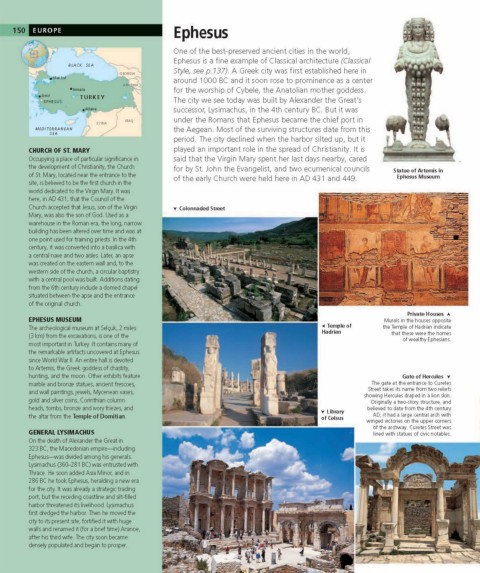
                                                     for by St. John the Evangelist,  and two ecumenical councils     Statue of  Artemis in
         of StMary, located near the entrance to the                                                                   Ephesus Museum
                                                     of the early Church w ere held here in AD 43 1 and 449.
         site, is believed to be the first church in the
         world dedicated to the Virgin Mary.  It was
         here, in AD 431 , that the C  ounci  I of the
         Church accepted that Jes us, son of the Virgin   Y  Colonnaded Street
         Mary, was  also the son of God. Used as a
         warehouse in the Roman era, the long, narrow
         building has been altered overtime  and was at
         one point used for traintng prtests. In the 4th
         century, it was converted into a  basilica wth
         a central nave and two atsles  later, an apse
         was created on the eastern wall and, to the
         western Side of the church, a  oraJar baptistry
         with a  central pool was bUilt.  Addtions datirg
         from the 6th century tndude a  domed chapel
          situated between the apse and the entrance
          of the original church
                                                                                                                          Private Houses  A
         EPHESUS MUSEUM                                                                                             Mur  a  Is in the houses opposite
         The archeological museum at Selt;uk, 2 miles                                                              the Temple of Hadrian indicate
                                                                                                                      that these were the homes
         (3 km) from the excavations, is  one of the
                                                                                                                         of weal thy Ephesians.
         most important in Turkey.  It contains  many of
         the remarkable  artifacts uncovered at Ephesus
         since World War II. An entire  hall is  devoted
         to Artemis,  the  Greek goddess of chastity,
         hunting, and the moon. Other exhibits  feature                                                                  Gate of  Hercules  Y
         marble  and bronze statues, ancient frescoes,                                                          The gate at the entrance  to Curetes
                                                                                                               Street takes its name from two reliefs
         and wall paintings , jewels, Mycenean vases,
                                                                                                              showing Hercules draped in a lion skin.
         gold and silver coins, Corinthian column                                                               Originally a two-story structure,  and
         heads, tombs , bronze and ivory friezes, and                                                         believed to date from the 4th century
         the altar from the Temple of Domitian.                                                                 AD, it  had a large central arch with
                                                                                                              winged victories on  the upper corners
                                                                                                                of the archway. Curetes Street was
          GENERAL LYSIMACHUS                                                                                    lined with statues of civic notables.
         On the death of  Alexander the Great tn
         323 BC, the Macedontan empire-including
         Ephesu~was  dMded among his generals.
         lysimachus (360-281 BC)was entrusted wth
          Thrace. He soon added Asia Mtnor, and tn
          286 BC he took Ephesus, heraldtng a  new era
         for the dty.lt was already a  strategtc trading
         port, but the receding coastline and silt-filled
         harbor threatened tts  live lihood. lysimachus
         first dredged the harbor. Then he moved the
         city to its present site, fortified it  Vllith huge
         walls and renamed it (for a  brief time) Arsinoe,
         after his  third Vllife. The city soon became
         densely populated and began to prosper.

