


Page 150 - DK Eyewitness Travel Guides - The World's Must-See Places
P. 150
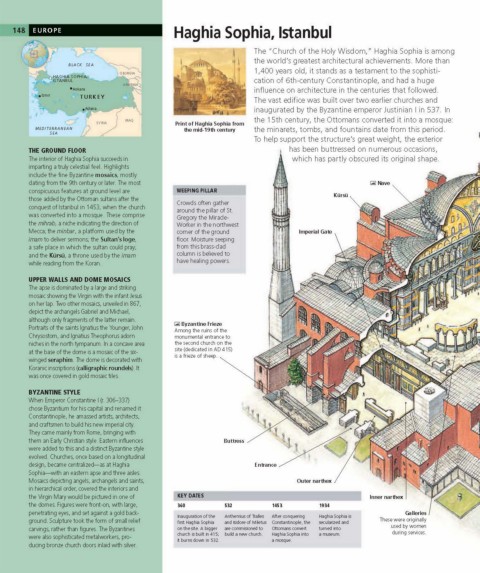
Haghia Sophia, Istanbul
     148  EUROPE

                                                                             The  nchurch of the Holy Wisdom," Haghia Sophia is among
                                                                             the world's greatest architectural achievements.  More than
                     BLACK  Sf A
                                                                             1,400 years old, it stands as a testament to the sophisti-
                                     GEORGIA
               t:a HAGHIA SOPHIA
                 ISTANBUL                ""                                  cation of 6th-century Constantinople, and had a huge
                                     A~_;
                                                                             influence on architecture in the centuries  that followed .
            •'zmlr
                                                                             The vast edifice w as  built over two earlier churches and
                         eAclana                                             inaugurated by the Byzantine emperor Justinian I in 537.  In
                                                                             the 15th century,  the Ottomans converted it into a mosque:
                                                     Print  of Haghia Sophia from
           M!f)ITERRANf AN                              the mid-19th century   the minarets, tombs, and fountains date from this period.
                Sf  A
                                                                             To  help support the structure's great weight,  the exterior
         THE GROUND FLOOR                                                              has been buttressed on numerous occasions,
         The  1  nterior of Haghia Sophia succeeds  in                                  which  has partly obscured  its original shape.
         imparting a  truly celestial feel. Highlights
         include the fine Byzantine mosaics, mostly
         dating from the 9th century or later. The most
         conspicuous features at ground level are    WEEPING PILLAR
         those added by the Ottoman sultans after the
                                                      Crowds  often gather
         conquest of Istanbul in 1453, when the church
                                                      around the pillar of St.
         was converted into a mosque. These compnse
                                                      Gregory the Miracle-
         the rnhrab, a  n1che indicating the direct1on of   Worker in the northwest
         Mecca, the minbar, a  platform used by the   comer of the ground
         imam to deliver sermons; the Sultan's loge,   floor. Moisture seeping
         a safe place in which the sultan could pray;   from this brass-dad
         and the Kursu, a  throne used by the imam    column is belie ved to
                                                      have healing powers.
         while reading from the Koran.

         UPPER WALLS AND DOME MOSAICS
          The  apse is  dominated by a  large and striking
         mosaic showing the Virgin with the infant Jesus
         on her lap  1\No other mosaics, urweiled in 867,
         depict the archangels Gabriel and Michael,
         although only fragments of the latter rema1n
                                                     ~ Byzantine  Frieze
         Portraits of the saints Ignatius the Younger, John
                                                     Among the ruins of the
         Chrysostom, and Ignatius Theoj:horus adorn   monumental entrance to
         n1ches in the north tympanum. In a  concave area   the second church on the
                                                     site (dedicated in AD 4 15)
         at the  base of the dome is  a  mosaic of the  s ix-
                                                     is a frieze of sheep.
         winged seraphim. The dome is decorated with
          Koranic inscriptions (calligraphic roundels).  It
         was  once covered in gold mosaic  tiles.

         BYZANTINE STYLE
         When Emperor Constantine I  (r. 306-337)
         chose Byzantium for his capital and renamed it
         Constantinople, he amassed artists, architects,
         and craftsmen to build his new imperial dty
         They came mainly from Rome, bringing with
         them an Early Christian style.  Eastern influences         Buttress
         were  added to this and a  distinct Byzantine  style
         evolved. C hurches, once based on a  longitudinal
         design, became centralize~as  at Haghia                             Entrance
         Sophia-with an eastern apse and three  ais les.
         Mosa1 cs depicting angels, archangels  and saints,                              Outer narthex
         in hierarchical order, covered the interiors and
         the Vtrg1n Mary would be pictured in one of   KEY DATES                                               Inner narthex
         the domes. Fig.Jres were front -on. wth large,   160       532           1453          1934
         penetrating eyes, and set against a  gold back·                                                                  Galleries
                                                      klauguratioo of  the   Atlthemlus of T rales   After conquering   Haghla Sophia is
         ground  Sculpture took the form of small relief   first Hagha SOphia   and ISidore of M  ~etus  Constantinople, the   secularized and   These were 04'iginally
         carvings, rather than figures. The Byzantines   on the site. A bigger   are commlsioned to   Ottomans con~~ert   turned into   used by women
                                                      church is built in 41 S ;  build a new church.   Hag hia Sophia into   a museum.   during services.
         were also sophisticated metalworkers, pro-
                                                      ~  burns dov.n in 532.      a rrosque.
         ducing bronze church doors inlaid with silver.

