


Page 169 - DK Eyewitness Travel Guides - The World's Must-See Places
P. 169
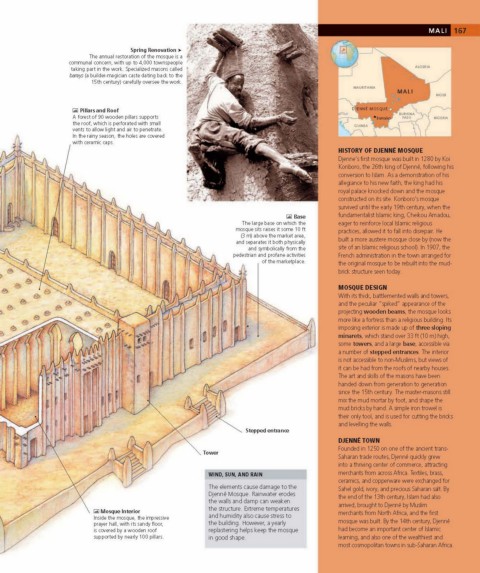
Spring Renovation ~
The annual restoration of the mosque is a .r.
communal concern, with up to 4,000 townspeople
taking part in the work. Specialized masons called •
bareys (a builder-magician caste dating back to the
15th century) carefully oversee the work.
NIGE.R
~ Pillars and Roof
A forest of 90 wooden pillars supports
the roof, which is perforated with small
vents to allow light and air to penetrate.
In the rainy season, the holes are covered
w1th ceramc caps
HISTORY OF DJENN£ MOSQUE
Djenne's first mosque was built in 1280 by Koi
Konboro, the 26th king of Djenne, following his
conversion to I slam. As a demonstration of his
allegiance to his new faith, the king had his
royal palace knocked down and the mosque
constructed on its site. Konboro's mosque
survived until the early 19th century, when the
~ Base fundamentalist Islamic king, Cheikou Amadou,
The large base on which the eager to reinforce local Islamic religious
mosque sits raises it some 10ft practices, allowed it to fall into disrepair. He
(3 m) above the market a rea,
and separates it both physically built a more austere mosque close by (now the
and symbolically from the site of an lslami c religious school). In 190 7, the
pedestrian and profane activities French administration in the town arranged for
of the marketplace. the original mosque to be rebuilt into the mud-
brick structure seen today.
MOSQUE DESIGN
With its thick, battlemented walls and towers,
e and the peculiar "spiked" appearance of the
) projecting wooden beams, the mosque looks
more I ike a fortress than a religious building. Its
imposing exterior is made up of three sloping
minarets, which stand over 33 ft ( 1 0 m) high,
some towers, and a large base, accessible via
a number of stepped entrances. The interior
is not accessible to non-Muslim s, but views of
it can be had from the roofs of nearby houses.
The art and ski lis of the masons have been
handed down from generation to generation
since the 15th century. The master-masons still
mix the mud mortar by foot, and shape the
mud bricks by hand. A simple iron trowel is
their only tool, and is used for cutting the bricks
and levelling the walls.
Stepped entrance
DJENN£TOWN
Founded in 12 50 on one of the ancient trans-
Tower
Saharan trade routes, Djenne quickly grew
into a thriving center of commerce, attracting
WIND, SUN, AND RAIN merchants from across Africa. Textiles, brass,
ceramics, and copperware were exchanged for
The elements cause damage to the Sahel gold, ivory, and precious Saharan salt By
Djenne Mosque. Rainwater erodes the end of the 13th century, Islam had also
the walls and damp can weaken
the structure. Extreme temperatures arrived, brought to Djenne by Muslim
~ Mosque Interior merchants from North Africa, and the first
Inside the mosque, the impressive and humidity also cause stress to
prayer hall, with its sandy floor, the building. However, a yearly mosque was built By the 14th century, Djenne
is covered by a wooden roof replastering helps keep the mosque had become an important center of lsi ami c
supported by nearly 100 pillars. in good shape. learning, and also one of the wealthiest and
most cosmopolitan towns in sub-Saharan Africa.

