


Page 164 - DK Eyewitness Travel Guides - The World's Must-See Places
P. 164
AFRICA                                    Abu Simbel


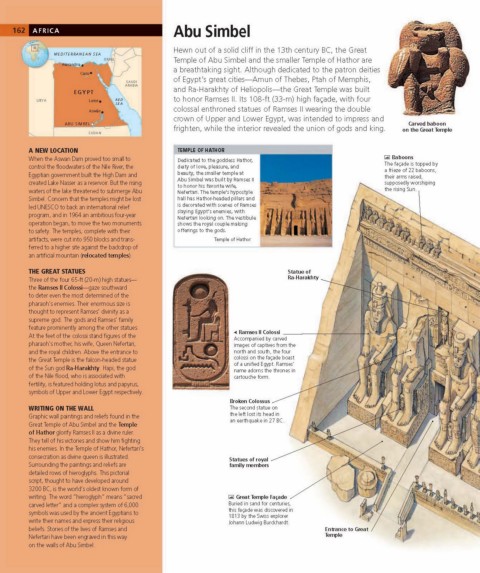
                                                     Hewn out of a solid cliff in the 13th century BC, the Great
                 MEDIT£11/IANEAN SEA
                                                     Temple of Abu Simbel and the smaller Temple of Hathor are
                                                     a breathtaking sight. Although dedicated to the patron deities
                                                     of Egypt's great cities- Amun of Thebes, Ptah of Memphis,
                                      SAUDI
                                      ARABIA
                                                     and Ra-Harakhty of  Heliopolis-the Great T emple was built
                       EGYPT
            1.18YA         lU:lO:Jre   RED           to honor Ramses II.  Its 108-ft (33-m) high fa~ade, with four
                                   SEA
                                                     colossal enthroned statues of Ramses II wearing  the double
                                                     crown of Upper and  L ower Egypt, was intended to impress and
                                                                                                                           Carved baboon
                                                     frighten, while the interior revealed  the union of gods and king.   on the Great Temple


         A NEW L OCATION                              TEMPLE  OF HATH OR
         When the  Aswan Dam proved too small to      Dedicated to the goddess Hathor,                             ~ Baboons
                                                                                                                   The fa<;ade is topped by
         control the  floodwaters  of the Nile Rive r, the   deity of love, pleasure, and                           a frieze of 22 baboons,
         Egyptian government built the High Dam and   beauty, the smaller temple at                                 their arms raised,
                                                      Abu Simbel was  built by Ramses  11
         created Lake Nas ser as a  reservoir.  But the  ris ing                                                    supposedly worshiping
                                                      to honor his favorite wife,
         waters  of the  lake  threatened to submerge  Abu   Nefertari. The temple's hypostyle                      the ris ing S un.
         S i  mbe l. Con  cern that the temples  might be  lost   hall has H  a  thor-headed p  II I  ars and
                                                      is decorated with scenes or  Ramses
         led UNESCO to back an international re lief
                                                      slaying Egypt's enemies, with
         program, and 1n 1964 an ambitious four-year
                                                      Nefertari looking on. The vestibule
         operat1on began, to move  the two monuments   shows the royal <ouple making
         to  safety  lhe temples, complete wrth the1r   offerings to the gods.
         arb  facts, were cut into 950 blocks  and trais-        Temple of Hathor
         ferred to a  higher site against the backdrop of
         an artif1c1 al mountain (relocated temples).

         THE GREAT STATUES                                                             Statue of
          T hree of the four 65-ft (20-m) high statues-                                Ra-Harakhty
         the Ramses II Colossi-gaze southward
         to deter even the most determined of the
         pharaoh's enemies.  Their enormous  SIZe IS
         thought to represent Ramses' divinity as a
         s~reme  god  The gods  and Ramses' family
         feattSe prominently among the other statues                   -< Ramses II Colossi  ____  ..;_  ___  .:..._  _ _  ---+,_
         At the feet of the colossi stG~Jd figures of the
                                                                       Accompanied by carved
         pharaoh's mother, his wife, Queen Ne fertari,                 images of captives from the
         and the  royal children.  Above the  entrance to   ~~~~iii  north and  south, the four
         the G reat T emple  is the falcon-headed statue   ~           colossi on the fao;ade boast
                                                                       of a unified Egypt Ramses'
         of the  S un god Ra-Harakhty. Hapi, the  god                  name adorns the thrones in
         of the  Nile  flood, who is associated with                   cartouche form.
         fertility, is  featured holding lotus and papyrus,
         symbols  of Upper and Lower Egypt respect1 vely
                                                                      Broken Colossus
         WRJnNG ON THE WALL                                          The second statue on
         Graphic wall paintings  and reliefs found 1n the             the left  lost its head in
                                                                      an earthquake in 27 BC.
         Great Temple of  Abu Simbe l and the T emple
         of Hath  or glorify Ramses  II as a div1ne  ruler.
         They te ll of his  victories and show him fighting
         his  enemies. In the Tern pie of H  ather, Ne fertari'  s
         consecration as divine queen is illus trated.
                                                                     Statues of royal
         S urrounding the  paintings and reliefs  are                family members
         detailed rows of hieroglyphs. This  pictorial
         script thought to have  developed around
         3200 BC.1s the world's  oldest known form of
         writ1ng  The word "hieroglyph" means "sacred                IOil  Great  Temple Fa~ade
         carved letter" and a  complex  system of  6,000             Buried in sand fcr centuries,
                                                                     this fao;ade was discCNered in
         symbols was used by the  andent Egyptians to
                                                                     1813 by the Swiss explcrer
         wnte the1r names  and express their rehg1 ous               Johann Ludwig Burckhardt
         belie fs. S tones of the lives o f Ramses and                                            Entran<e to Great
         Ne fertari have been engraved in this  way                                               Temple
         on the  walls  of Abu Simbel.

