


Page 228 - DK Eyewitness Travel Guides - The World's Must-See Places
P. 228
226  AUSTRALASIA                                Dunedin Railway Station


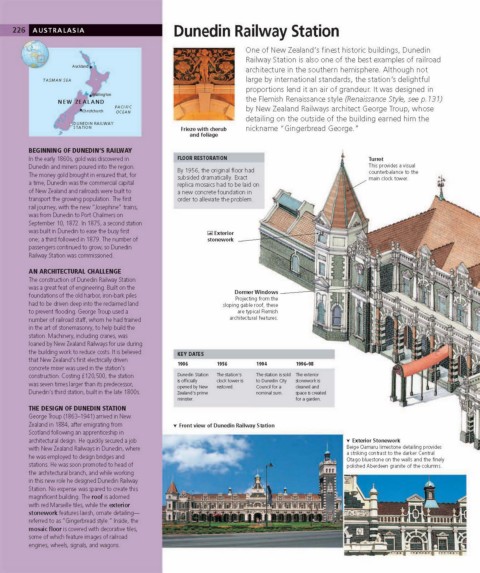
                                                                          One of New Zealand's finest historic buildings, Dunedin
                                                                          Railway Station is  also one of the best examples of railroad
                           .  '
                      Auckland •
                                                                          architecture in the southern hemisphere. Although not
              TASMAW SEA                                                  large by international standards, the station's delightful
                                                                          proportions lend it an air of grandeur.  It was designed  in
                           .~ellington
                                                                          the Flemish  Renaissance style (Renaissance Style, see p.131)
                  NEW  ZEALAND
                                   PAC/ FIC                               by New Zealand Railways architect George Troup, whose
                         •ch r;stchu rch   oc EAW
                                                                          detailing on the outside of the building earned him the
                       DUNEDIN RAILWAY
                       STATION
                                                       Frieze with <herub   nickname  II Gingerbread George. II
                                                         and foliage
         BEGINNING OF DUNEDIN'S RAILWAY
         In the early 1860s, gold was discovered in   FLOOR RESTORATION                                        Turret
         Dunedin and miners poured into the region.                                                            This provides a visual
                                                      By  1956, the original floor had                         counterbalance to the
          The money go I d brought in ensured that, for
                                                      subsided dramatically. Exact                             main clock tower.
         a time, Dunedin was the commercial capital   replica mosaics had to be laid on
         of New Zealand and railroads were built to   a new concrete foundation in
         transport the growing population. The first   order to alleviate the p rob I em.
         rail journey, with the new" Josephine"  trains,
         was from Dunedin to Port Chalmers on
         September 10,  1872. In 1875, a second station
         was built in Dunedin to ease the busy first           ~ Exterior
         one; a third foil owed in 1879. The number of         stonework
         passengers continued to grow, so Dunedin
         Railway Station was commissioned.

         AN ARCHITECTURAL CHALLENGE
          The construction of Dunedin Rai lvvay Station
         was a great feat of engineering. Built on the                 Dormer Windows __ _::S~~~~~~tij~
         foundations of the old harbor, iron-bark piles
                                                                       Projecting from the
         had to be driven deep into the reclaimed land             sloping gable roof, these
         to prevent flooding. George Troup used a                       are typical Flemish
         number of railroad staff, whom he had trained               architectural features.
         in the art of stonemasonry, to help build the
         station. Machinery, including cranes, was
         loaned by New Zealand Railways for use during
         the building work to reduce costs. It is believed   KEY DATES
         that New Zealand's first electrically driven
                                                      1906        1956       1994        1996--98
         concrete mixer was used in the station's
         construction. Costing f 12 0, 500, the station   Dunedin Station   The station's   The station is sold  The exterior
                                                      is officially   cbck tower is   to Dunedin City   9.onevv'Ork is
         was seven times I arger than its predecessor,
                                                      opened by New   restored.   Council for a   cleaned and
         Dunedin's third station, built in the late 1800s.   Zealand's prime   nominal sum.   space is created
                                                      minister.                          for a garden.
         THE DESIGN OF DUNEDIN STATION
         George Troup (1863-1941) arrived in New
         Zealand in 1884, after emigrating from      Y Front view of Dunedin Railway Station
         Scotland foil owing an apprenticeship in
         architectural design. He quickly secured a job                                                 Y  Exterior Stonework
         with New Zealand Railways in Dunedin, where                                                    Beige Oamaru I imes tone detailing provides
                                                                                                        a striking contrast to the darker Central
         he was employed to design bridges and
                                                                                                        Otago blueston e on  the walls and  the  finely
         stations. He was soon promoted to head of                                                      polished Aberdeen  granite of the columns.
         the architectural branch, and while working
         in this new role he designed Dunedin Railway
         Station. No expense was spared to create this
         magnificent building. The roof is adorned
         with red Marseille tiles, while the exterior
         stonework features lavish, ornate detailing-
         referred to as "Gingerbread style." Inside, the
         mosaic floor is covered with decorative tiles,
         some of which feature images of railroad
         engines, wheels, signals, and wagons.

