


Page 26 - DK Eyewitness Travel Guides - The World's Must-See Places
P. 26
24  EUROPE                                     Edinburgh Castle


                                                     Standing on the basalt core of an extinct volcano, Edinburgh
                                                     Castle is a remarkable assemblage of buildings dating from the
                                                     12th to the 20th centuries, reflecting its changing role as  fortress,
            A TlAIVTIC    O EDINBURGH                royal  palace,  military garrison, and state prison.  There is  evidence
             OCEAIV
                           CASTLE   IVORTH
                                    Sf A             of Bronze Age occupation of the site, which takes its name from
                         GREAT
                         BRITAIN                     Dun Eidin, a Celtic fortress captured by King Oswald of North umbria
                 IRUANO
                                                     in the 7th century.  The castle was a favorite royal  residence until   Beam support in
                     Birmingham •
                                                                                                                            the Great Hall
                          london •                   the Union of the Crowns in  1 603, after which the king resided  in
                                                     England. After the Union of Parliaments in  1707, the Scottish  regalia (Crown
                                                     Jewels) were walled up in the palace for more than 100 years.  The castle is  now
                                                     the zealous  possessor of the so-called  Stone of Destiny, a relic of ancient Scottish
         STONE OF DESTINY
         The origins of this famous stone are steeped in   kings  that was seized  by the English and not returned until 1996.
         myth and legend. It is said to have been Jacob's
         pillow when he dreamed that the angels of
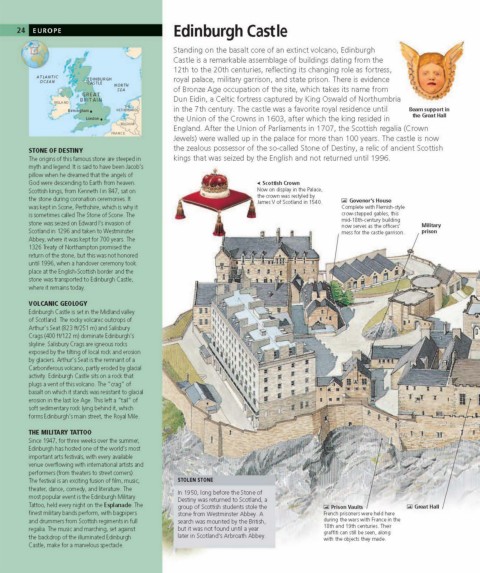
         God were descending to Earth from heaven.                           ~ Scottish Crown
         Scottish kings, from  Kenneth I in 84 7, sat on                      Now on display in the Palace,
                                                                              the crown was restyled by
         the stone during coronation ceremonies.lt                                                     ~ Govenor's House
                                                                              James V of Scotland in 1540.
         was kept in Scone, Perthshire, which is why it                                                Complete with Flemish-style
         is sometimes called The Stone of Scone. The                                                   crow-stepped gables,  this
                                                                                                       mid-18th-century building
         stone was seized on Edward l's invasion of
                                                                                                       now serves as the officers'   Military
         Scotland in  1296 and taken to Westminster                                                    mess for the castle garrison.   prison
         Abbey, where it was kept for 700 years. The
          1326 Treaty of Northampton promised the
         return of the stone, but this was not honored
         unti I 1996, when a handover ceremony took
         place at the English-Scottish border and the
         stone was transported to Edinburgh Castle,
         where it remains today.

         VOLCANIC GEOLOGY
         Edinburgh Castle is set in the Midland valley
         of Scot I and. The rocky volcanic outcrops of
         Arthur's Seat (823 tt/251 m) and Salisbury
         Crags (400ft/122m) dominate Edinburgh's
         skyline. Salisbury Crags are igneous rocks
         exposed by the tilting of local rock and erosion
         by glaciers. Arthur's Seat is the remnant of a
         Carboniferous volcano, partly eroded by glacial
         activity. Edinburgh Castle sits on a rock that
         plugs a vent of this volcano. The "crag" of
         basalt on which it stands was resistant to glacial
         erosion in the last Ice Age. This left a "tail" of
         soft sedimentary rock lying behind it, which
         forms Edinburgh's main street, the Royal Mile.

         THE MILITARY TATTOO
         Si nee  194 7, for three weeks over the summer,
         Edinburgh has hosted one of the world's most
         important arts festivals, with every available
         venue overflowing with international artists and
         performers (from theaters to street corners)
         The festival is an exciting fusion of film, music,   ~  STOLEN STONE
         theater, dance, comedy, and literature. The
                                                      In  19 50, long before the Stone of
         most popular event is the Edinburgh Military
                                                      Destiny was returned to Scotland, a
         Tattoo, held every night on the Esplanade. The   group of Scottish students stole the   ~ Prison Vaults          ~ Great Hall
         finest military bands perform, with bagpipers   stone from Westminster Abbey. A         French prisoners were held here
         and drummers from Scottish regiments in full   search was mounted by the British,       during the wars with France in the
         regalia. The music and marching, set against   but it was not found until a year        18th and 19th centuries. Their
                                                                                                 graffiti can still be seen, along
         the backdrop of the illuminated Edinburgh    later in Scotland's Arbroath Abbey.        with the objects they made.
         Castle, make for a marvelous spectacle.

