


Page 30 - DK Eyewitness Travel Guides - The World's Must-See Places
P. 30
28


            A  T!Af'JT/C
             OCEAI'J      • Edinburgh
                                   f'JORTH
                        GREAT       SEA
                       BR ITAIN
                             o YORK
                 IRUAND       MINSTE R    1
                                    NHHI~NO!!'
                     B  irm i'Ogham •
                           london  1


         STAINED GLASS
         York Minster has an exceptional collection of
         medieval stained glass. The glass was generally
         colored during production, using meta  I oxides
         to produce the desired color, then worked on
         by craftsmen on site. When a design had been
         produced, the glass was first cut, then trimmed
         to shape. Details were painted on using iron
         OXIde-based paints that were fused to the glass
         by finng in a  kiln.  lndividJal pieces were then
         leaded together to form the finished window
         Part of  the fasonation of  the minster glass1s
         its vanety of subject matter. Some Vlllndows,
         including the Great East Window, were paid
         for by lay donors who specified a particular
         subject; others reflect ecclesiastical patronage,

         THE DECORATED GOTHIC STYLE
         An example  of this second phase of Gothic
         archrtecture in England (c 1275-1380) is the
         Chapter House, which radiates elegantly
         aga1nst the back<top of  York Minster. Delicate
         carvings, fine stained-glass windows, elaborate
         tracery, and experimental vaulting typify the
         Decorated Gothic style. Carvings  of foliage,
         animals, and human figures can be viewed
         above the stalls. Inside the nave, complex
         tracery can be seen throughout

         YORK MYSTERY PLAYS
          These 48 medieval dramas, which relate the
         h1story of the world from the mystery of God's
         creation to the Last Judgment, were ongnally
         performed between the 14th and the 16th
         centuries for the feast of  Corpus CIY1sti. The
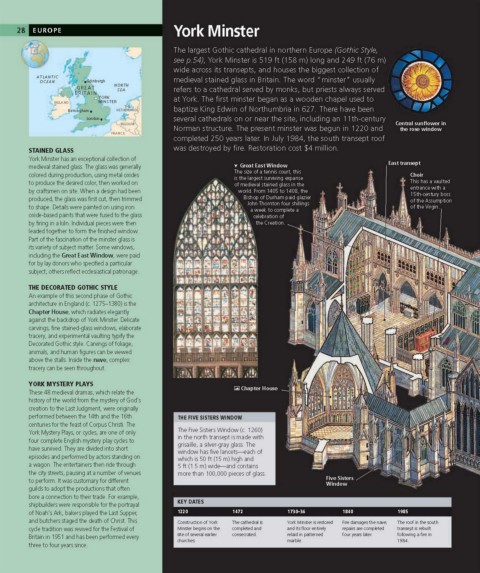
                                                      The Five Sisters Window (c 1  260)
         York Mystery Plays, or cycles, are one of only
                                                      in the north transept is made with
         four complete English mystery play cycles to
                                                      grisaille, a silver-gray glass. The
         have  s urvived. They are divided into short
                                                      window has five lancets-each of
         episodes and performed by actors standing on   which is 50ft (1 5m) high and
         a wagon. The entertainers then ride through   5  ft (1.5 m) wide-and contains
         the city streets, pausing at a  number of venues   more than  100,000 pieces of glass.
         to perform. It was customary for different
         guilds to adopt the productions that often
         bore a  connection to their trade. For example,
         snpbUIIders were responsible for the portrayal
         of Noah's Ark, bakers played the Last Supper,
         and butchers staged the death of Christ.  ThiS
         cycle tradition was revived for the Festival of
         Britain in 1951  and has been performed every
         three to four years since.

