


Page 260 - DK Eyewitness Travel Guides - The World's Must-See Places
P. 260
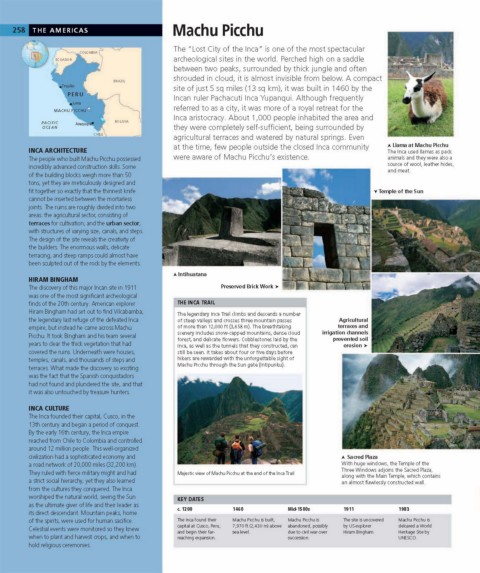
Machu Picchu


                                                     The  II Lost City of the Inca II  is one of the most spectacular
                                                     archeological sites in the world. Perched high on a saddle
                                                     between two peaks, surrounded by thick jungle and often
                                                     shrouded in cloud, it is almost invisible from below. A compact
                                   BRAZIL
                                                     site of just 5 sq miles (  13 sq  km),  it was built in 1460 by the
                                                     lncan ruler Pachacuti Inca Yupanqui. Although frequently
                                                     referred to as a city, it  was more of a royal retreat for the
                                                     Inca aristocracy. About 1,000 people inhabited the area and
             PACifiC
              OCEA W                                 they w ere completely self-sufficient, being surrounded by
                                                     agricultural terraces and watered  by natural springs.  Even
                                                     at the time, few people outside the closed Inca community      A Llama at  Machu Picchu
         INCA ARCHITEC tuRE                                                                                         The Inca used llamas as pack
         The people who built Machu Picchu possessed   were aware of Machu  Picchu's existence.                      anima Is and they w ere also a
         incredibly advanced construction skills. Some                                                               source of wool, leather hides,
                                                                                                                     and meat.
         of the building blocks weigh more than SO
         tons, yet they are meticulously designed and
         fit together so exactly that the thinnest knife
         cannot be inserted between the mortarless
         joints. The ruins are roughly divided into two
         areas: the agricultural sector, consisting of
          terraces for cultivation, and the urban sector,
         with structures of vary1 ng size, canals, and steps.
          The deSign of the Site reveals the creativity of
         the bu1lders  The enormous walls, delicate
         terraang, and steep ramps could almost have
         been sculpted out of the rock by the elements.

                                                     A lntihuatana
         HIRAM BINGHAM
          The discovery of th1s maJor lncan site 10 1911           Preserved Brick Work >
         was one of the most sig11ficant archeolog1cal
         finds of the 20th century  Amencan explorer   THE INCA TRAIL
          Hiram B1ngham had set out to fmd Vileabamba,
                                                      The legendary Inca Trail climbs and descends a number
         the legendary last refuge of the defeated Inca   of steep valleys and crosses three mountain passes   Agricultural
         empire, but 1nstead he came across Machu     of more than 12,000 ft (3,65B m). The breathtaking   terraces and
                                                      scenery includes snow-capped mountains, dense cloud   irrigation channels
         Picchu. It took B 1ngham and h1s team several
                                                      forest, and delicate flowers.  Cobblestones laid by the   prevented soil
         years to clear the th1ck vegetation that had   Inca, as well as the tunnels that they constructed, can
         covered the ruins. Underneath were houses,   still be seen. It takes about four or five days  before
         temples, canals, and thousands of steps and   hikers are rewarded with the unforgettable sight of
                                                      Machu Picchu through the Sun gate (lntlpunku).
         terraces. What made the discovery so exciting
         was the fact that the Spanish conquistadors
         had not found and plundered the site, and that
         it was also untouched by treasure hunters


         INCA CULTURE
          The Inca founded the1r caprtal, Cusco, in the
          13th century and began a penod of conquest.
         By the early 16th century, the Inca empire
         reached from Chile to Colombia and controlled
         around 12 mllhon people  Tlis well-orgamzed
         dvilizatlon had a sophisticated economy am                                                    A  Sa <red Plaza
          a road network of 20,000 m1les (32,200 km)                                                   With huge wind  <MIS, the Temple of the
                                                                                                       Three Wind<MIS adjoins the Sacred Plaza,
          They rued wth fierce m1htary m1ght and had   Majestic view of Mach.J Picchu at the end of the Inca Trail   along with the Main Temple, which contains
          a strict soaal herarcl)t, yet they also learned                                              an almost flawlessly constructed wall .
         from the cultures they conquered  The Inca
         worshiped the natural world, see1ng the Sun   KEY D ATES
         as the ultimate g1 ver of life and the1r leader as
                                                      c. 1200         1460             Micl-1500s      1911             1983
         its direct descendant  Mountain peaks, home
         of the spints, were used for human sacifice.   The Inca found their   Machu Picchu is built,   Machu Picchu is   The site is uncovered   Machu Picchu is
                                                      cap~al  at Cusco, Peru,   7,970 It  (2,430 m) above   abandoned, possibly   by US explorer   delcared a World
         Celestial events were monitored so they knew
                                                      and begin their far·   sea le~Jel.   due to civil waroVE'r   Hiram Bingham.   Her~age  S ite by
         when to plant and harvest crops, and when to   reaching expansion.            succession.                      UNESCO.
         hold rei igious ceremonies.

