


Page 255 - DK Eyewitness Travel Guides - The World's Must-See Places
P. 255
MEXICO
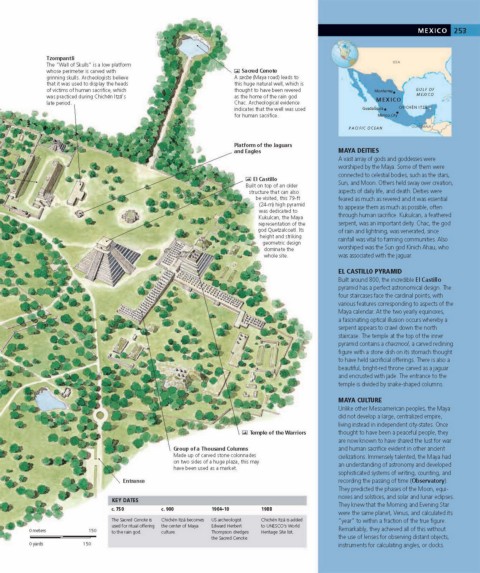
Tzompantli
The "Wall of Skulls" is a low platform USA
whose perimeter is carved with ~ Sa <red Cenote
grinning skulls. Archeologists believe A sacbe (Maya road) leads to
that it was used to display the heads this huge natura I well, which is
of victims of human sacrifice, which thought to have been revered
was practiced during Chich~n ltz~'s as the home of the rain god
Ia te period. C hac. Archeological evidence
indicates that the well was used Guadala~ro e CHICH EN I TzA
for human sacrifice. lli'e'liCCJ..PtY"
PAC/ FIC OCEAr.l
Platform of the Jaguars
and Eagles MAYA DEITIES
A vast array of gods and goddesses were
worshiped by the Maya. Some of them were
connected to celestial bodies, such as the stars,
Sun, and Moon. Others held sway over creation,
Built on top of an older
structure that can also aspects of daily life, and death. Deities were
be visited, this 79-ft feared as much as revered and it was essential
(24-m) high pyramid to appease them as much as possible, often
was dedicated to
Kukulcan, the Maya through human sacrifice. Kukulcan, a feathered
representation of the serpent, was an important deity. Chac, the god
god Quetzalcoatl. Its of rain and lightning, was venerated, since
height and striking rainfall was vital to farming communities. Also
geometric design
dominate the worshiped was the Sun god Kinich Ahau, who
whole site. was associated with the jaguar.
EL CASTILLO PYRAMID
Built around 800, the i ncrecjibl e E I Castillo
pyramid has a perfect astronomical design. The
four staircases face the cardinal points, with
various features corresponding to aspects of the
Maya calendar. At the two yearly equinoxes,
a fascinating optical illusion occurs whereby a
serpent appears to crawl down the north
staircase. The temple at the top of the inner
pyramid contains a chacmoo/, a carved reclining
figure with a stone dish on its stomach thought
to have held sacrificial offerings. There is also a
beautiful, bright-red throne carved as a jaguar
and encrusted with jade. The entrance to the
temple is divided by snake-shaped columns.
MAYA CULlURE
Unlike other Meso<;~merican peoples, the Maya
did not develop a large, centralized empire,
living instead in independent city-states. Once
thought to have been a peaceful people, they
are now known to have shared the lust for war
Group of a Thousand Columns and human sacrifice evident in other ancient
Made up of carved stone colonnades civilizations. lm mensely talented, the Maya had
on two sides of a huge pi aza, this may an understanding of astronomy and developed
have been used as a market.
sophisticated systems of writing, counting, and
recording the passing of time (Observatory).
They predicted the phases of the Moon, equi-
noxes and solstices, and solar and I unar eclipses.
KEY DATES
They knew that the Morning and Evening Star
(, 750 c.900 1904-10 1988
were the same planet, Venus, and calculated its
The Sa:red Cenote is Chichen ltza becomes US archeologist Chichen ltza is added "year" to within a fraction of the true figure.
used for ritual offering the center of Maya Edward Herbert to UNESCO's v..brld
150 to the rain god. culture. Thompson dredges Heritage Site list. Remarkably, they achieved all of this without
the Sacred Cenote. the use of lenses for observing distant objects,
0 yards 1 so instruments for calculating angles, or clocks.

