


Page 70 - DK Eyewitness Travel Guides - The World's Must-See Places
P. 70
68  EUROPE                                     Bremen Town Hall


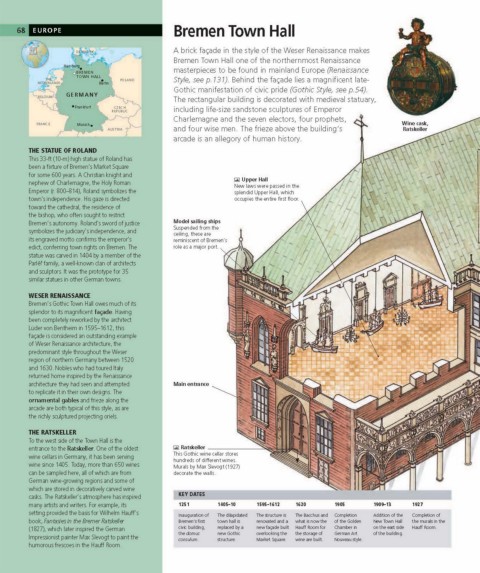
                                                     A brick fa~ade in  the style of the Weser Renaissance makes
                                                     Bremen Town Hall one of the northernmost Renaissance
                    Hamburg•
                                                     masterpieces to be found  in  mainland Europe (Renaissance
                      ()~~':NE~ALL
              THl, ,:C               POLAND          Style, seep. 131).  Behind  the fa~ade lies a magnificent late-
            NlTHlRIANDS
          '~                                         Gothic manifestation of civic pride (Gothic Style, see p.54).
                                                     The rectangular building  is  decorated with medieval statuary,
                                                     including life-size sandstone sculptures of Emperor
                                                     Charlemagne and the seven  electors,  four prophets,
            FRANCE                                                                                                       Wine cask,
                                                     and four wise men. The frieze above the building's                  Ratslceller
                                                     arcade is  an allegory of human history.

         THE STATUE OF ROLAND
         This 33-ft (10-m) high statue of Roland has
         been a fixture of Bremen's Market Square
         for some 600 years. A Christian knight and
                                                                       ~ Upper Hall
         nephew of Charlemagne, the Holy Roman
                                                                       New laws were passed in the
         Emperor (r  800--314), Roland symbolizes the                  splendid Upper H a II, which
         town's independence. His gaze is directed                     occupies the entire first floor.
         toward the cathedral, the residence of
         the bishop, who often sought to restrict
         Bremen's autonomy. Roland's sword of justice   Model sailing ships
                                                     Suspended from the
         symbolizes the judiciary's independence, and
                                                     ceiling, these are
         its engraved motto confirms the emperor's   reminiscent of Bremen's
         edict, conferring town rights on Bremen. The   role as a major port
         statue was carved in 1404 by a member of the
         Parler family, a well-known clan of architects
         and sculptors. It was the prototype for 35
         similar statues in other German towns.

         WESER RENAISSANCE
         Bremen's Gothic Town Hall owes much of its
         splendor to its magnificent fa~de.  Having
         been completely reworked by the architect
         Ludervon Bentheim in 1595-1612, this
         f  a~ade is considered an outstanding example
         of Weser Renaissance architecture, the
         predominant style throughout the Weser
         region of northern Germany between 152 0
         and 1630. Nobles who had toured Italy
         returned home inspired by the Renaissance
         architecture they had seen and attempted    Main entrance
         to replicate it in their own designs. The
         ornamental gables and frieze along the
         arcade are both typical of this style, as are
         the richly sculptured projecting oriels.

         THE RATSKELLER
          To the west side of the Town Hall is the
         entrance to the Ratskeller. One of the oldest   ~ Ratskeller ~~;;:-----=~~-,~~~~
         wine cellars in Germ any, it has been serving   This Gothic wine cellar stores    ..,.,.~,_.
                                                     hundreds of different wines.              -~""""'""'
         wine since  1405. Today, more than 650 wines
                                                     Murals by Max Slevogt(1927)
         can be sampled here, all of which are from   decorate the walls.
         German wine-growing regions and some of
         which are stored in decoratively carved wine
         casks. The Ratskeller' s atmosphere has inspired   KEY DATES
         many artists and writers. For example, its   1251        1405-10    1595-1612   1620        1905       1909-13     1927
         setting provided the basis for Wilhelm Hauff's
                                                      Inauguration of   The dilapidated   The structure is   The Bacchus and   Completbn   Addition of the   Completion of
         book, Fantasies in the Bremer Ratske/113'    Bremen's first   town hall is   renovated and a   what is now the   of the Golden   New Town Hall   the murals in the
         ( 182 7), which later inspired the Germ an   civi: building,   replaced by a   new fac;ade built   Hauff Room for   Chamber in   on the east side   Hauff Room.
                                                      the domus   new Gothic   overlooking the   the storage of   German Art   of the building.
         Impressionist painter Max Slevogt to paint the   mnsulum.   structure.   Market Square.   wine are built   Nouveau style.
         humorous frescoes in the Hauff Room.

