


Page 74 - DK Eyewitness Travel Guides - The World's Must-See Places
P. 74
72  EUROPE                                     Wurzburg Residence


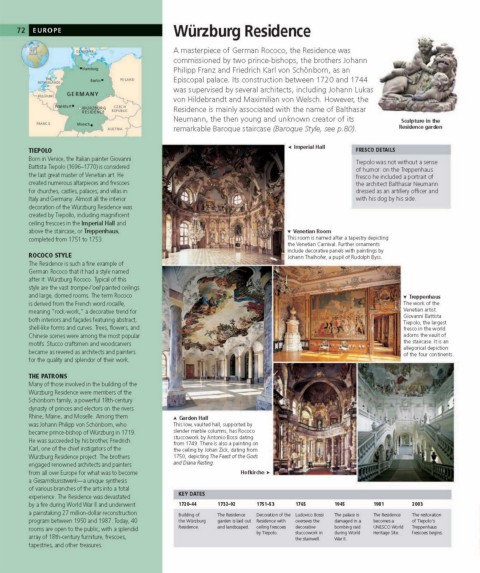
                                                     A masterpiece of German Rococo, the Residence was
                                                     commissioned by two prince-bishops, the brothers Johann
                                                     Philipp Franz and Friedrich Karl von  Schon born, as an
                                                     Episcopal  palace.  Its construction between 172 0 and  17 44
                                                     was supervised by several architects, including Johann Lukas
                                                     von Hildebrandt and Maximilian von Welsch.  However, the
                                                     Residence is  mainly associated with  the name of Balthasar
                                                     Neumann, the then young and unknown creator of its                  Swlpture in the
                                                     remarkable Baroque staircase (Baroque Style, see p.BO).            Residen<e garden


                                                                                       -<  Imperial Hall
         TIEPOLO                                                                                           FRESCO  DETAILS
         Born in Venice, the ltali an painter Giovanni
                                                                                                           Tiepolo was not without a sense
         Battista Tiepolo (1696-1770) is considered
                                                                                                           of humor  on the Treppenhaus
         the last great master of Venetian art He                                                          fresco he included a portrait of
         created numerous altarpieces and frescoes                                                         the architect Balthasar Neumann
         for churches, castles, palaces, and villas in                                                     dressed as an artillery officer and
         Italy and Germany. Almost all the interior                                                        with his dog by his side.
         decoration of the Wurzburg Residence was
         created by Tiepollo, including magnificent
         ceiling frescoes in the Imperial Hall and
         above the staircase, or T reppenhaus,                                         Y  Venetian Room
         completed from 17 51  to 17 53.                                               This room is named after a tapestry depi<ting
                                                                                       the Venetian Carnival. Further ornaments
                                                                                       in<lude de<Or ative panels with paintings by
         ROCOCO STYLE                                                                  Johann Tha lhofer, a pu pi I of Rudolph Byss.
          The Residence is such a fine exam pie of                     ~>;;j~~·
         German Rococo that it had a style named
         after it Wurzburg Rococo. Typical of this
         style are the vast ffompe-1' oei/ painted ceilings
         and large, domed rooms. The term Rococo                                                                         Y Treppenhaus
         is derived from the French word rocai!le,                                                                       The work of the
         meaning "rock-work," a decorative trend for                                                                     Venetian artist
                                                                                                                         Giovanni Battista
         both interiors and fa<;ades featuring abstract,
                                                                                                                         Tiepolo, the largest
         shell-like forms and curves. Trees, flowers, and                                                                fres<O in the world
         Chinese scenes were among the most popular                                                                      adorns the vault of
         motifs. Stucco craftsmen and woodcarvers                                                                        the stair<ase. It is an
                                                                                                                         a lleg ori<a I dep i<tion
         became as revered as architects and painters                                                                    of the four <On tinents.
         for the quality and splendor of their work.

         THE PATRONS
         Many of those involved in the building of the
         Wurzburg Residence were members of the
         Schonborn family, a powerful  18th-century
         dynasty of princes and electors on the rivers
         Rhine, Maine, and Moselle. Among them       A  Garden Hall
         was Johann Philipp von Schonborn, who       This I ow, v au I ted hall, supported by
         became prince-bishop ofWurzburg in 1719.    slender marble <Oiumns, has Ro<o<o
                                                     stu«owork by Antonio Bossi  dating
         He was succeeded by his brother, Friedrich   from 1749. There is also a painting on
         Karl, one of the chief instigators of the   the <eiling by Johan Zi<k, dating from
         Wurzburg Residence project. The brothers    1750, depi<ting The Feast of the Gods
         engaged renowned architects and painters   and Diana Resting.
         from all over Europe for what was to become                     Hofkir<he >-
         a GesamtkunsiJNerk-a unique synthesis
         of various branches of the arts into a total
                                                      KEY DATES
         experience. The Residence was devastated
         by a fire during World War II  and underwent   172G-44   1732-92    1751-53     1765        1945       1981        2003
         a painstaking 2 7 mi IIi on-dollar reconstruction   Building of   The Residence   Decoratbn of the  Ludovi:o Bossi   The palace is   The Residence   The restoration
         program between 19 50 and 1987. Today, 40    the Wurzburg   garden is laid out  Residence with   oversees the   damaged in a   becomes a   of Tiepolo's
         rooms are open to the public, with a splendid   Residence.   and landscaped.   ceiling frescoes   decorative   bombing raid   UNESCO VIK>rld   Treppenhaus
                                                                             byTiepolo.   stUCCOINOrk in   during World   Heritage S~e.   frescoes begins.
         array of 18th-century furniture, frescoes,                                      the stairwelL   war 11.
         tapestries, and other treasures.

