


Page 87 - DK Eyewitness Travel Guides - The World's Must-See Places
P. 87
AUSTRIA 85
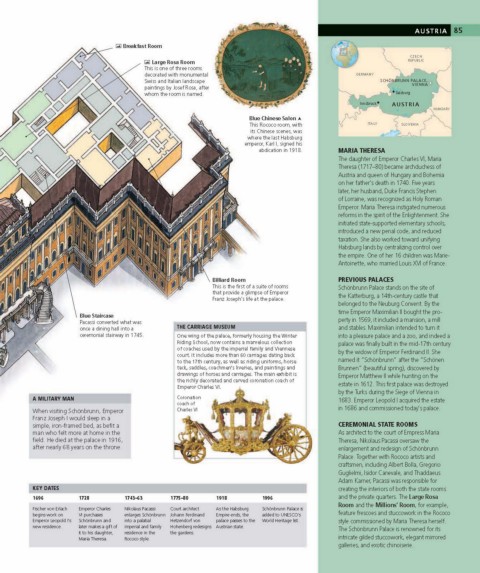
~ Breakfast Room
CZECH
~ large Rosa Room REPUBLIC
This is one of three rooms
decorated with monumental
Swiss and Italian landscape
paintings by Josef Rosa, after
whom the room is named.
Blue Chinese Salon A
This Rococo room, with
its Chinese scenes, was
where the last Habsburg
emperor, Karl I, signed his
abdication in 1918. MARIA THERESA
The daughter of Emperor Charles VI, Maria
Theresa ( 1717 -80) became archduchess of
Austria and queen of Hungary and Bohemia
on her father's death in 1740. Five years
later, her husband, Duke Francis Stephen
of Lorraine, was recognized as Holy Roman
Emperor. Maria Theresa instigated numerous
reforms in the spirit of the Enlightenment She
initiated state-supported elementary schools,
introduced a new penal code, and reduced
taxation. She also worked toward unifying
Habsburg I ands by centralizing control over
the empire. One of her 16 children was Marie-
Antoinette, who married Louis XVI of France.
PREVIOUS PALACES
This is the first of a suite of rooms Schonbrunn Palace stands on the site of
that provide a glimpse of Emperor
Franz Joseph's life at the palace. the Katterburg, a 14th-century castle that
belonged to the Neuburg Convent By the
time Emperor Maximilian II bought the pro-
perty in 1 S69, it included a mansion, a mill
Pacassi converted what was
once a dining hall into a THE CARRIAGE MUSEUM and stables. M aximi I ian intended to turn it
ceremonial stairway in 1745. One wing of the palace, formerly housing the Winter into a pi easure palace and a zoo, and indeed a
Riding S<hool, now <Ontains a marvelous <OIIe<tion palace was finally built in the mid-17th century
of <oa<hes used by the imperial family and Viennese by the widow of Emperor Ferdinand II. She
<Ourt. It in<ludes more than 60 <arriages dating ba<k
to the 17th <entury, as well as riding uniforms, horse named it "Schonbrunn" after the "Schonen
ta<k, saddles, <oa<hmen's liveries, and paintings and Brunnen" (beautiful spring), discovered by
drawings of horses and <arriages. The main exhibit is
Emperor Matthew II while hunting on the
the ri<hly de<Orated and <arved <Oro nation <oa<h of
Emperor Charles VI. estate in 1612. This first palace was destroyed
by the Turks during the Siege of Vienna in
A MILITARY MAN Coronation 1683. Emperor Leopold I acquired the estate
<oa<h of
When visiting Schonbrunn, Emperor Charles VI in 1686 and commissioned today' s palace.
Franz Joseph I would sleep in a
simple, iron-framed bed, as befit a CEREMONIAL STATE ROOMS
man who felt more at home in the As architect to the court of Empress Maria
field. He died at the palace in 1916, Theresa, Nikolaus Pacassi oversaw the
after nearly 68 years on the throne. enlargement and redesign of Schonbrunn
Palace. Together with Rococo artists and
craftsmen, including Albert Bolla, Gregorio
Guglielmi, lsidor Canevale, and Thaddaeus
Adam Karner, Pacassi was responsible for
KEY DATES creating the interiors of both the state rooms
1696 1728 1743-'3 1775-80 1918 1996 and the private quarters. The Large Rosa
Room and the Millions' Room, for example,
Fischer \JOn Erla<h Emperor Charles Nikolaus Pa<assi Court architect As the Habsburg Schonbrunn Pala<e 5
begins work on VI purchases enlarges Schonbrunn Johann Ferdinand Empire ends, the added to UNESCO's feature frescoes and stuccowork in the Rococo
Emperor Leopold l's Schonbrunn and into a palatial Hetzendorf \JOn pala<e passes to the V1K>rld Heritage li;t. style commissioned by Maria Theresa herself.
new residence. later makes a g~tof imperial and family Hohenberg redesigns Austrian state. The Schonbrunn Palace is renowned for its
~ to his daughter, residence in the the gardens.
Maria Theresa. Rococo style. intricate gilded stuccowork, elegant mirrored
galleries, and exotic chi noi serie.

