


Page 82 - DK Eyewitness Travel Guides - The World's Must-See Places
P. 82
80  EUROPE                                     St. Gallen Monastery


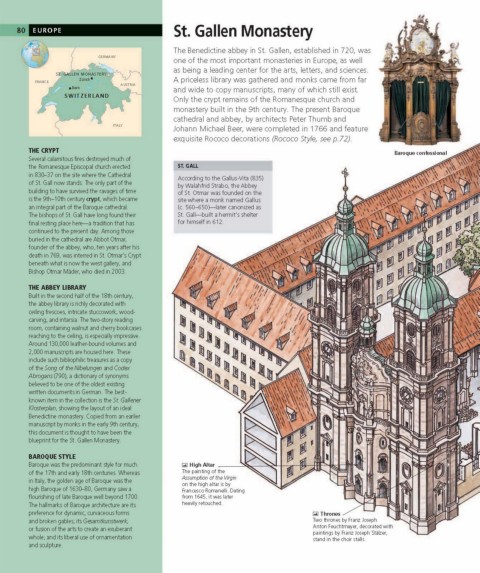
                                                     The Benedictine abbey in St.  Galien, established in  720, was
                                                     one of the most important monasteries in Europe, as well
                                                     as being a leading center for the arts,  letters, and sciences.
                  S~'GALLEN MONASTERY
                         ZuriCh •                    A priceless library was gathered and monks came from far
           fRANC l
                     e8Cill'n
                                                     and wide to copy manuscripts, many of which still exist.
                    SWITZERLAND
                                                     Only the crypt remains of the Romanesque church and
                                                     monastery built in the 9th century. The present Baroque
                                                     cathedral and abbey, by architects Peter Thumb and
                                   ITALY
                                                     Johann  Michael Beer, were completed in  1766 and feature
                                                     exquisite Rococo decorations (Rococo Style, see pJ2).

         THE C RYPT
         Several calamitous fires destroyed much o f
         the Romanesque Episcopal church erected      ST. GALL
         in 830--37 on the  s ite where  the Cathedral
                                                      According to the Gallus-Vita (835)
         of S  t  Gall now stands. The only part of the
                                                      by Walahfrid S trabo, the  Abbey
         building to have survived the ravages of time   of St Otmar was founded on the
         is the 9th- 1Oth century crypt which became   site where a monk named Gallus
         an integral part of the Baroque cathedral    (c  560- 650)--later canonized as
          The  bishops of S  t Gall have long found their   St. Gall- built a  hermit's  shelter
         final resting pi ace here-a tradition that has   for himself in 612.
         continued to the present day. Among those
         buried in the cathedral are Abbot Otmar,
         founder of the abbey, who, ten years after his
         death in 769, was 1nterred 1n St Otmar's Crypt
         beneath what is now  the west gallery, and
         Bishq:> Otmar Mader, who ded 1n 2003

         THE ABBEY  UBRARY
         Built in the second half of  the 18th century,
         the al:bey hbrary 1s ridiy deccrated wth
         ceiling frescoes, Intricate stuccowork, wood-
         carving, and 1ntarsia  The two-story reading
         room, containing walnut and cherry bookcases
         reaching  to the ceiling, is especially impressive.
         Around 1 30,000 leather-bound volumes and
         2, 000 manuscripts are housed here. T hese
         include  s uch bibliophilic  treasures as a  copy
         of the  S ong of the Nibelungen a nd Codex
         Abrogans  (790), a dictionary of synonyms
         believed to be one of the oldest existing
         written documents 1 n German.  The best-
         known item in the collection is the St. Gallener
         Klosterplan, showing the layout of an ideal
         Benedictine monastery. Copied from an earlier
         manuscript by monks in the early 9th century,
         ttis  document IS thought to have been the
         blueprint for the St  Galien Monastery

          BAROQUE S TYLE
         Baroque was the predommant style fcr much     ~  High Altar  -----=~...------=::~4-.:,.,rr-~-fiF,.,.(d-
          of the 17th and early 18th centunes  Whereas   The painting of the
                                                       Assumption of  the V~rgin
         in Italy, the golden age of Baroque was the
                                                       on the high altar is by
         high Baroque of 1630--80, Germany saw a       Francesco Romanelli. Dating
         flourishing of late Baroque well beyond 1700.   from 1645, it  was later
         T he hallmarks of Baroque architecture are its   heavily retouched.
         preference for dynamic, curvaceous forms                                             ~ Thrones
         and broken gables; 1ts Gesamtkunstvverk,                                             Two thrones by Franz Joseph
                                                                                              Anton Feuchtmayer, decorated with
         or fus ion of the  arts to create an exuberant
                                                                                              paintings by Franz J oseph S talzer.
         whole; and its  liberal use of ornamenta tion                                        stand in the choir stalls.
         and sculpture.

