


Page 23 - (DK Eyewitness) Travel Guide - Australia
P. 23
INTRODUCING A USTR ALIA 21
A PORTRAIT
OF AUSTRALIA
Australia is the world’s oldest continent, inhabited for more than 60,000
years by Aborigines. It was settled by the British during their maritime heyday,
in 1788, and since then has transformed from a colonial outpost into a
nation with a population of more than 24 million people. For visitors, its
ancient, worn landscape contrasts with the vitality and youthful energy
of its inhabitants.
Covering an area as large as the United Australian trees shed their bark rather
States of America or the entire European than their leaves, the native flowers have
continent, Australia’s landscape is highly no smell and, with the exception of the
diverse, encompassing the dry Outback, wattle, bloom only briefly.
the high plateaus of the Great Dividing Australia has a unique collection of
Range, the lush woods of Tasmania, fauna. Most are marsupials, such as
the rainforests and coral reefs of the the kangaroo and koala. The platypus
tropical north and almost 36,000 km and echidna are among the few living
(22,300 miles) of mainland coastline. mammals that both lay eggs and suckle
The Great Dividing Range forms a spine their young. The dingo, Australia’s first
down eastern Australia, from Queensland introduced species, arrived from Southeast
to Victoria, separating the fertile coastal Asia more than 5,000 years ago and is
strip from the dry and dusty interior. considered the country’s native dog.
Dominating the vegetation is the Australia’s antiquity is nowhere more
eucalypt, known as the “gum tree”, evident than in the vast inland area
of which there are some 500 varieties. known as the Outback.
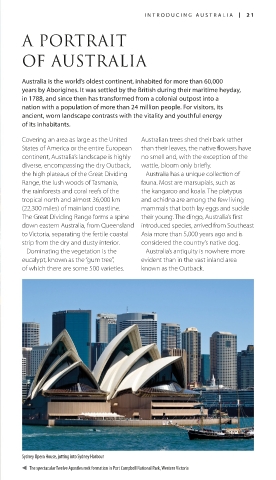
Sydney Opera House, jutting into Sydney Harbour
The spectacular Twelve Apostles rock formation in Port Campbell National Park, Western Victoria

