


Page 282 - (DK Eyewitness) Travel Guide - Australia
P. 282
280 THE NOR THERN TERRIT OR Y
4 Kakadu National Park
The vast 19,757 sq km (7,628 sq miles) of Kakadu
National Park, with its stunning diversity of stony
plateaux, red escarpment cliffs, waterfalls, billabongs,
long twisting rivers, flood plains and coastal flats,
is one of Australia’s most extraordinary places.
A UNESCO World Heritage Area (see pp30–31), Kakadu
encompasses both scenic wonders and huge galleries
of Aboriginal rock art. The park is Aboriginal land
leased back to the government (see p63) and is
managed jointly. The entire catchment area of
the South Alligator River lies within the park, Wildman River
and is home to thousands of plant and West Alligator River South Alligatot River
animal species. Some areas in Kakadu are
not accessible during the wet season. Four
Mile
Hole
Two Mile Hole Kakadu
Holiday
Village
Cooinda
( (O
Jim Jim (Old Darwin) Road
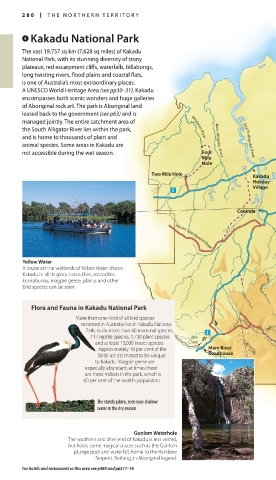
Yellow Water
A cruise on the wetlands of Yellow Water shows
Kakadu in all its glory. Lotus lilies, crocodiles,
kookaburras, magpie geese, jabirus and other
bird species can be seen.
Flora and Fauna in Kakadu National Park
More than one-third of all bird species
recorded in Australia live in Kakadu National J
Park; as do more than 60 mammal species,
117 reptile species, 1,700 plant species Pine J
and at least 10,000 insect species. Creek
Approximately 10 per cent of the Mary River
birds are estimated to be unique Roadhouse
to Kakadu. Magpie geese are
especially abundant; at times there
are three million in the park, which is
60 per cent of the world’s population.
The stately jabiru, seen near shallow
water in the dry season
Gunlom Waterhole
The southern and drier end of Kakadu is less visited,
but holds some magical places such as the Gunlom
plunge pool and waterfall, home to the Rainbow
Serpent, Borlung, in Aboriginal legend.
For hotels and restaurants in this area see p489 and pp517–18

