


Page 382 - (DK Eyewitness) Travel Guide - Australia
P. 382
380 VIC T ORIA
Melbourne’s Best: Architecture
In 1835, Melbourne was a village of tents and impermanent
dwellings. Fed by the wealth of the 1850s’ gold rush and
the economic boom of the 1880s, it rapidly acquired many
graceful buildings. Today, the city’s architecture is very
eclectic, with a strong. Victorian element. The range of
architectural styles is impressive, from beautiful restorations
to outstanding contemporary novelties. The city’s tallest
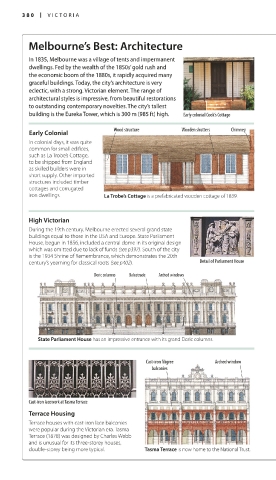
building is the Eureka Tower, which is 300 m (985 ft) high. Early colonial Cook’s Cottage
Early Colonial Wood structure Wooden shutters Chimney
In colonial days, it was quite
common for small edifices,
such as La Trobe’s Cottage,
to be shipped from England
as skilled builders were in
short supply. Other imported
structures included timber
cottages and corrugated
iron dwellings. La Trobe’s Cottage is a prefabricated wooden cottage of 1839.
High Victorian
During the 19th century, Melbourne erected several grand state
buildings equal to those in the USA and Europe. State Parliament
House, begun in 1856, included a central dome in its original design
which was omitted due to lack of funds (see p397). South of the city
is the 1934 Shrine of Remembrance, which demonstrates the 20th
century’s yearning for classical roots (see p402). Detail of Parliament House
Doric columns Balustrade Arched windows
State Parliament House has an impressive entrance with its grand Doric columns.
Cast-iron filigree Arched window
balconies
Cast-iron lacework at Tasma Terrace
Terrace Housing
Terrace houses with cast-iron lace balconies
were popular during the Victorian era. Tasma
Terrace (1878) was designed by Charles Webb
and is unusual for its three-storey houses,
double-storey being more typical. Tasma Terrace is now home to the National Trust.

