


Page 378 - (DK Eyewitness) Travel Guide - Australia
P. 378
376 VIC T ORIA
Victoria at a Glance
The state of Victoria can be easily divided into Mildura
two distinct geographical halves, east and
west. Western Victoria is known for its unusual
landforms, including the Grampians and the
Twelve Apostles. It was also the site of
Australia’s wealthiest gold rush during the
19th century, the legacy of which can be seen
in the ornate buildings in the many surviving
gold rush towns (see pp58–9). Eastern Victoria’s Western Victoria
cooler climate benefits the vineyards that (see pp426–41)
produce world-class wines, while the Alps
are Victoria’s winter playground. The rugged
coastline is known for its lakes, forests and
wildlife. Melbourne, the state’s capital, is the
second most populous city in Australia.
Horsham
Ballarat
Portland Geelong
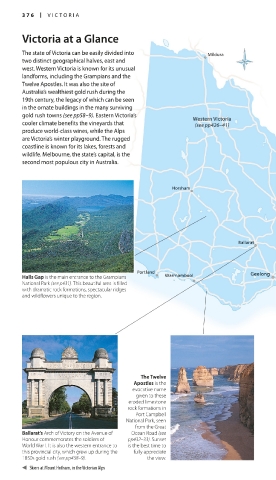
Halls Gap is the main entrance to the Grampians Warrnambool
National Park (see p431). This beautiful area is filled
with dramatic rock formations, spectacular ridges
and wildflowers unique to the region.
The Twelve
Apostles is the
evocative name
given to these
eroded limestone
rock formations in
Port Campbell
National Park, seen
from the Great
Ballarat’s Arch of Victory on the Avenue of Ocean Road (see
Honour commemorates the soldiers of pp432–33). Sunset
World War I. It is also the western entrance to is the best time to
this provincial city, which grew up during the fully appreciate
1850s gold rush (see pp438–9). the view.
Skiers at Mount Hotham, in the Victorian Alps

