


Page 397 - (DK Eyewitness) Travel Guide - Australia
P. 397
MELBOURNE 395
block is now a city landmark. This attitude was sanctioned Today, Chinatown is known for
Its communications tower was by government policy. its restaurants and Chinese
for many years the highest point The Chinese were charged a produce shops, with the com-
in the city, at 265 m (869 ft). poll tax in most states of £10 munity’s calendar culminating
Original 1908 Federation-style each – a huge sum, particularly in its New Year celebrations in
professional chambers, built on as many were peasants. Even January or February (see p45).
the grounds of the 1867 St harsher was a restriction on Ironically, in view of the early
Michael’s Uniting Church, are the number of passengers prejudices, this community is
incorporated into the building. that boat-owners could carry. now one of Australia’s oldest
This acted as a disincentive and most successful.
for them to bring Chinese
immigrants to Australia. iMuseum of
What resulted were “Chinese
marathons”, as new arrivals Chinese Australian
dodged the tax by landing in History
“free” South Australia and
walking to the gold fields, 22 Cohen Place (off Little Bourke St).
covering distances of up to Map 2 D2. Tel (03) 9662 2888.
800 km (500 miles) (see pp58–9). £ Parliament. v Swanston & Bourke
As an immigrant society in sts routes. Open 10am–4pm daily.
Melbourne, the Chinese were Closed 1 Jan, Good Fri, 25 Dec. &
7 8 ∑ chinesemuseum.com.au
highly organized and self-
sufficient. A city base was Opened in 1985 to preserve
established during the 1850s, the heritage of Australians of
utilizing the cheap rental Chinese descent, this museum
district of the city is in the heart of Chinatown.
centre. As with other The subjects of its displays
Chinatowns around range from the influx of
Chambers at No. 120 Collins Street the world, traders could Chinese gold-seekers in
live and work in the the 1850s to exhibitions
uChinatown same premises and of contemporary Chinese
act as a support art, thus offering a
Little Bourke St. Map 2 D2.
£ Parliament. v Swanston & network for other comprehensive history
Bourke sts routes. Chinese immigrants. of the Chinese in
The community Victoria and their
When Chinese immigrants largely avoided cultural background.
began arriving in Melbourne prejudice by starting The second floor
to seek gold during the 1850s, up traditional Asian holds regular touring
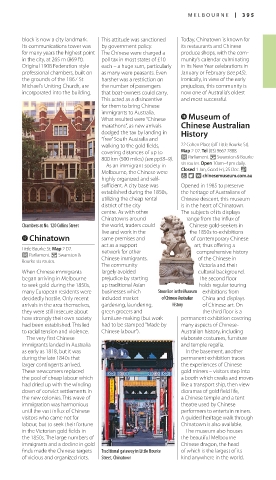
many European residents were businesses which Stone lion in the Museum exhibitions from
decidedly hostile. Only recent included market of Chinese Australian China and displays
arrivals in the area themselves, gardening, laundering, History of Chinese art. On
they were still insecure about green grocers and the third floor is a
how strongly their own society furniture-making (but work permanent exhibition covering
had been established. This led had to be stamped “Made by many aspects of Chinese-
to racial tension and violence. Chinese labour”). Australian history, including
The very first Chinese elaborate costumes, furniture
immigrants landed in Australia and temple regalia.
as early as 1818, but it was In the basement, another
during the late 1840s that permanent exhibition traces
larger contingents arrived. the experiences of Chinese
These newcomers replaced gold miners – visitors step into
the pool of cheap labour which a booth which creaks and moves
had dried up with the winding like a transport ship, then view
down of convict settlements in dioramas of gold field life,
the new colonies. This wave of a Chinese temple and a tent
immigration was harmonious theatre used by Chinese
until the vast influx of Chinese performers to entertain miners.
visitors who came not for A guided heritage walk through
labour, but to seek their fortune Chinatown is also available.
in the Victorian gold fields in The museum also houses
the 1850s. The large numbers of the beautiful Melbourne
immigrants and a decline in gold Chinese dragon, the head
finds made the Chinese targets Traditional gateway in Little Bourke of which is the largest of its
of vicious and organized riots. Street, Chinatown kind anywhere in the world.

