


Page 401 - (DK Eyewitness) Travel Guide - Australia
P. 401
MELBOURNE 399
the 1920s gangster Squizzy sMelbourne birds, fish and hundreds of
Taylor, last man hanged Ronald Museum insects. This gallery explores
Ryan and infamous Chopper the complex ecosystem of
Read all having been locked up Carlton Gardens, Melbourne. Australia’s temperate forests,
here. The experience is enhanced Map 2 D1. Tel (03) 8341 7777. using plants and animals,
by informative multimedia v 86, 96. Open 10am–5pm daily. art and multimedia instal
Closed Good Fri, 25 Dec.
displays that illustrate the & - = 7 lations, soundscapes and
stories of former inmates. other activities.
∑ museumvictoria.com.au/
melbournemuseum There is also a dedicated
aLygon Street Housed in an ultramodern gallery for children, featuring
a dinosaur dig to excavate
facility in verdant Carlton fossils, a discovery garden
Lygon St, Carlton. Map 1 C1. v 1, 8.
@ 200, 207, 955, 966. Gardens, it has exhibits over six and museum objects, as
levels, half of which are below well as Aboriginal storytelling
This Italianinfluenced street is ground level. Diverse displays and sculptures.
one of the main café, restaurant offer insights into science, One of the most popular
and delicatessen areas in central technology, the environment, exhibits is in the Australia
Melbourne (see pp526). the human mind and body, Gallery. It displays the life of
The strong Italian Australian society and Phar Lap, the champion
tradition of Lygon indigenous cultures. Australian racehorse of the
Street began at the One of the early 1930s. Exhibits include
time of mass post highlights is Bunjilaka, race memorabilia of the period.
World War II the Aboriginal Centre. Phar Lap himself is seen in an
immigration. With a It combines exhibition ArtDeco inspired showcase.
general exodus to the galleries with a perform Other curiosities on show in
suburbs in the 1940s, ance space and meeting the museum include the skel
Carlton became rooms. Wurreka, the eton of a blue whale, a car from
unfashionable and 50m (150ft) long Melbourne’s first tram, a
new immigrants zinc wall etching at windmill and the Hertel, the
were able to buy its the entrance is first car to be imported.
19thcentury houses Coffee grinder in by Aboriginal Adjacent to the Melbourne
and shops cheaply. a Lygon Street artist Judy Watson. Museum is the Royal
More importantly, coffee house On the Milarri Garden Exhibition Building, offering
the immigrants were trail, you can learn an interesting 19thcentury
central in protecting these about traditional uses of counterpoint to the Museum’s
Victorian and Edwardian indigenous plants and explore modern architecture. The
houses, which were built with a cave decorated with Exhibition Building was built for
postgold rush wealth, from Aboriginal paintings. the 1880 International
government plans to fill the The Forest Gallery is a living, Exhibition and is one
area with lowincome Housing breathing exhibit, featuring of the few remaining structures
Commission homes. 8,000 plants from 120 different from the 19thcentury world
A distinctive architectural trait species. It is also home to fairs. It was designed by Joseph
of Lygon Street’s twostorey around 20 different vertebrate Reed, whose work can be
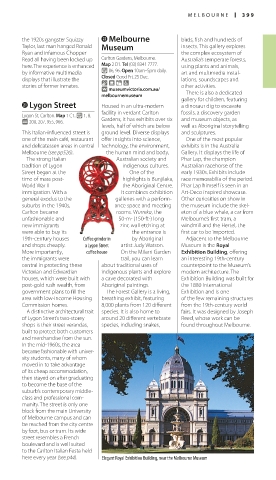
shops is their street verandas, species, including snakes, found throughout Melbourne.
built to protect both customers
and merchandise from the sun.
In the mid1960s, the area
became fashionable with univer
sity students, many of whom
moved in to take advantage
of its cheap accommodation,
then stayed on after graduating
to become the base of the
suburb’s contemporary middle
class and professional com
munity. The street is only one
block from the main University
of Melbourne campus and can
be reached from the city centre
by foot, bus or tram. Its wide
street resembles a French
boulevard and is well suited
to the Carlton Italian Festa held
here every year (see p44). Elegant Royal Exhibition Building, near the Melbourne Museum

