


Page 64 - (DK Eyewitness) Travel Guide - Australia
P. 64
62 INTRODUCING A USTR ALIA
Australians fought alongside following World War II,
the Americans in the Pacific 800,000 of whom were not
and nearly 250,000 US troops British. In 1956, the status
spent time in Australia during of “permanent resident”
the war. This led, in 1951, to allowed non-Europeans to
the signing of Australia’s first claim citizenship. In 1958,
defence treaty with a foreign the dictation entry test
country: the ANZUS treaty was abolished. Yet until
between Australia, New 1966 non-Europeans had
Zealand and the United States. to have 15 years’ residence
Again, war affected most before gaining citizenship,
Australian communities and as opposed to five years
towns. Nearly one million of for Europeans.
Australia’s seven million
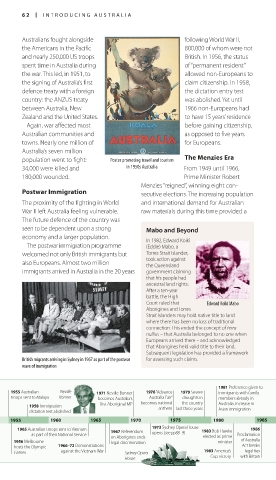
population went to fight: Poster promoting travel and tourism The Menzies Era
34,000 were killed and in 1950s Australia From 1949 until 1966,
180,000 wounded. Prime Minister Robert
Menzies “reigned”, winning eight con-
Postwar Immigration secutive elections. The increasing population
The proximity of the fighting in World and international demand for Australian
War II left Australia feeling vulnerable. raw materials during this time provided a
The future defence of the country was
seen to be dependent upon a strong Mabo and Beyond
economy and a larger population. In 1982, Edward Koiki
The postwar immigration programme (Eddie) Mabo, a
welcomed not only British immigrants but Torres Strait Islander,
also Europeans. Almost two million took action against
the Queensland
immigrants arrived in Australia in the 20 years government claiming
that his people had
ancestral land rights.
After a ten-year
battle, the High
Court ruled that Edward Koiki Mabo
Aborigines and Torres
Strait Islanders may hold native title to land
where there has been no loss of traditional
connection. This ended the concept of terra
nullius – that Australia belonged to no one when
Europeans arrived there – and acknowledged
that Aborigines held valid title to their land.
Subsequent legislation has provided a framework
British migrants arriving in Sydney in 1967 as part of the postwar for assessing such claims.
wave of immigration
1981 Preference given to
1955 Australian Neville 1971 Neville Bonner 1976 “Advance 1979 Severe immigrants with family
troops sent to Malaya Bonner becomes Australia’s Australia Fair” droughts in members already in
1958 Immigration first Aboriginal MP becomes national the country Australia. Increase in
anthem last three years
dictation test abolished Asian immigration
1955 1960 1965 1970 1975 1980 1985
1973 Sydney Opera House
1965 Australian troops sent to Vietnam 1967 Referendum 1983 Bob Hawke 1986
as part of their National Service on Aborigines ends opens (see pp88–9) elected as prime Proclamation
1956 Melbourne legal discrimination minister of Australia
hosts the Olympic 1966–72 Demonstrations Act breaks
Games against the Vietnam War Sydney Opera 1983 America’s legal ties
House Cup victory with Britain

