


Page 60 - (DK Eyewitness) Travel Guide - Australia
P. 60
58 INTRODUCING A USTR ALIA
The 1850s Gold Rush
Gold was discovered near Bathurst in New South Wales
and at Ballarat and Bendigo in Victoria in 1851. Established
towns were almost deserted as men from all over the
country, together with immigrants from Europe and China,
rushed to the gold fields. Some became extremely wealthy,
while others returned empty-handed. By the 1880s,
Australia was a prosperous country and cities were lined
with ornate architecture, some of which was constructed
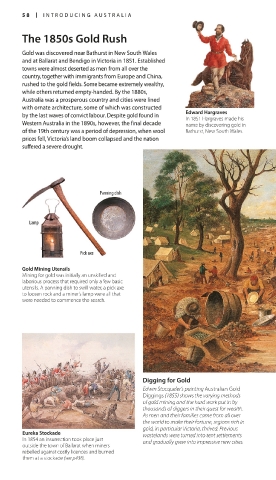
by the last waves of convict labour. Despite gold found in Edward Hargraves
In 1851 Hargraves made his
Western Australia in the 1890s, however, the final decade name by discovering gold in
of the 19th century was a period of depression, when wool Bathurst, New South Wales.
prices fell, Victoria’s land boom collapsed and the nation
suffered a severe drought.
Panning dish
Lamp
Pick axe
Gold Mining Utensils
Mining for gold was initially an unskilled and
laborious process that required only a few basic
utensils. A panning dish to swill water, a pick axe
to loosen rock and a miner’s lamp were all that
were needed to commence the search.
Digging for Gold
Edwin Stocqueler’s painting Australian Gold
Diggings (1855) shows the varying methods
of gold mining and the hard work put in by
thousands of diggers in their quest for wealth.
As men and their families came from all over
the world to make their fortune, regions rich in
gold, in particular Victoria, thrived. Previous
Eureka Stockade wastelands were turned into tent settlements
In 1854 an insurrection took place just and gradually grew into impressive new cities.
outside the town of Ballarat when miners
rebelled against costly licences and burned
them at a stockade (see p438).

