


Page 72 - (DK Eyewitness) Travel Guide - Australia
P. 72
70 SY DNEY
Sydney’s Best: Architecture
For such a young city, Sydney possesses a great diversity of
architectural styles. They range from the simplicity of Francis
Greenway’s Georgian buildings (see p177) to Jørn Utzon’s (see p177) to Jørn Utzon’s (see p177
Expressionist Sydney Opera House (see pp88–9). Practical
colonial structures gave way to elaborate Victorian edifices
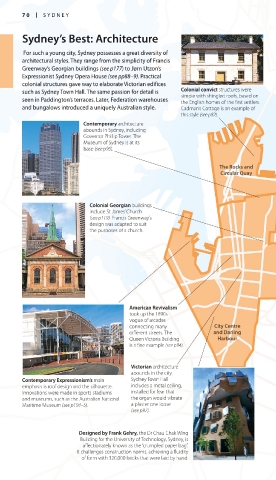
such as Sydney Town Hall. The same passion for detail is Colonial convict structures were
simple with shingled roofs, based on
seen in Paddington’s terraces. Later, Federation warehouses the English homes of the first settlers.
and bungalows introduced a uniquely Australian style. Cadman’s Cottage is an example of
this style (see p82).
Contemporary architecture
abounds in Sydney, including
Governor Phillip Tower. The
Museum of Sydney is at its
base (see p96).
The Rocks and
Circular Quay
Colonial Georgian buildings
include St James’ Church
(see p119). Francis Greenway’s
design was adapted to suit
the purposes of a church.
American Revivalism
took up the 1890s
vogue of arcades
connecting many City Centre
different streets. The and Darling
Queen Victoria Building Harbour
is a fine example (see p94).
Victorian architecture
abounds in the city.
Contemporary Expressionism’s main Sydney Town Hall
emphasis is roof design and the silhouette. includes a metal ceiling,
Innovations were made in sports stadiums installed for fear that
and museums, such as the Australian National the organ would vibrate
Maritime Museum (see p104–5). a plaster one loose
(see p97).
Designed by Frank Gehry, the Dr Chau Chak Wing
Building for the University of Technology, Sydney, is
affectionately known as the “crumpled paper bag”.
It challenges construction norms, achieving a fluidity
of form with 320,000 bricks that were laid by hand.

