


Page 74 - (DK Eyewitness) Travel Guide - Australia
P. 74
72 SY DNEY
Sydney’s Best: Parks and Reserves
Sydney is almost completely surrounded by national
parks and intact bushland. There are also a number
of national parks and reserves within Greater Sydney
itself. Here, the visitor can gain some idea of how the
landscape looked before the arrival of European settlers.
The city parks, too, are filled with plant and animal life.
The more formal plantings of both native and exotic
species are countered by the indigenous birds and
animals that have adapted and made the urban
environment their home. One of the highlights of a trip
to Sydney is the huge variety of birds to be seen, from
large birds of prey such as sea eagles and kites,
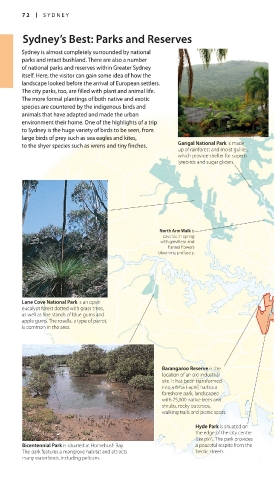
Garigal National Park is made arigal National Park is made arigal National Park
to the shyer species such as wrens and tiny finches. G G
up of rainforest and moist gullies,
which provide shelter for superb
lyrebirds and sugar gliders.
North Arm Walk is
covered in spring
with grevilleas and
flannel flowers
blooming profusely.
Lane C
Lane Cove National Park is an open ove National Park is an open ove National Park
Lane C
eucalypt forest dotted with grass trees,
as well as fine stands of blue gums and
apple gums. The rosella, a type of parrot,
is common in the area.
Barangaroo Reserve is the
location of an old industrial
site. It has been transformed
into a 6-ha (-acre) harbour
foreshore park, landscaped
with 75,000 native trees and
shrubs, rocky outcrops,
walking trails and picnic spots.
H H Hyde Park is situated on yde Park is situated on yde Park
the edge of the city centre
(see p97). The park provides
Bic
Bicentennial Park is situated at Homebush Bay. entennial Park is situated at Homebush Bay. entennial Park a peaceful respite from the
Bic
The park features a mangrove habitat and attracts hectic streets.
many water birds, including pelicans.

