


Page 82 - (DK Eyewitness) Travel Guide - Australia
P. 82
80 SY DNEY
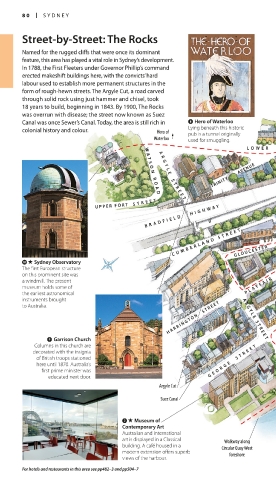
Street-by-Street: The Rocks
Named for the rugged cliffs that were once its dominant
feature, this area has played a vital role in Sydney’s development.
In 1788, the First Fleeters under Governor Phillip’s command
erected makeshift buildings here, with the convicts’ hard
labour used to establish more permanent structures in the
form of rough-hewn streets. The Argyle Cut, a road carved
through solid rock using just hammer and chisel, took
18 years to build, beginning in 1843. By 1900, The Rocks
was overrun with disease; the street now known as Suez
Canal was once Sewer’s Canal. Today, the area is still rich in 8 Hero of Waterloo
colonial history and colour. Hero of Lying beneath this historic
pub is a tunnel originally
Waterloo used for smuggling.
L OWER FOR T STREE T
W
A
R
A T
TRINITY AVENUE
G
S
Y
O
L
N
E
R
S
T
O
R
A
E
D
E
S T R E E T T
U P P E R F O R T
B R A D F I E L D H I G H W A Y Y
B R A D F I E L D H I G H W A
C U M B E R L A N D S T R E E T
G L O U C E S T E R
0. Sydney Observatory
The first European structure
on this prominent site was
a windmill. The present P L A Y F A I R S T R E E T
museum holds some of
the earliest astronomical
instruments brought
H A R R I N G T O N S T R E E T T A R G Y L E S T R E E T
H A R R I N G T O N S T R E E
to Australia.
9 Garrison Church
Columns in this church are
decorated with the insignia
of British troops stationed G E O R G E S T R E E T
here until 1870. Australia’s
first prime minister was
educated next door.
Argyle Cut
Suez Canal
2. Museum of
Contemporary Art
Australian and international
art is displayed in a Classical Walkway along
building. A café housed in a Circular Quay West
modern extension offers superb foreshore
views of the harbour.
For hotels and restaurants in this area see pp482–3 and pp504–7

