


Page 83 - Esquire (November 2019)
P. 83
Three days later. It’s the first Sunday
                                         of the NFL’s regular season. Thirteen
                                         games  are  on  the  schedule,  which           Nabb as well as Rashad Jennings, whose career on Dancing with
            means twenty-six teams are playing, which means the betting op-              the Stars is more distinguished than his career in professional foot-
            portunities are aplenty. DraftKings, the second-most-popular                 ball. Or maybe it’s an issue of convenience: Why bother going to
            mobile-betting operator in New Jersey, has decided to make an                a party to place bets when you can do so from your phone?
            event of it, holding a pop-up party with a few former NFL play-                 Ali, twenty-nine, like several attendees I meet, is a carpetbag-
            ers at a bar not far from Hoboken Terminal. The vibe is upbeat,              ging gambler. “It’s just annoying that we can’t do it in New York,”
            though contrived. Maybe it’s the cost—fifty dollars, unless you’ve           he shouts over the din of four games blaring from four television
            been designated one of the app’s VIP players—or the company:                 screens. “It’s stupid.” Until that changes, he’s limited by the va-
            Guest appearances include legitimate onetime star Donovan Mc-                garies of geography and time. “Unfortunately, I can’t bet weekly,
                                                                                         because I don’t have the time to come in every week.” (Ali, like
                                                                                         everyone else I spoke to for this story, despite my best efforts to
                                                                                         find otherwise, is a man.)
                                                                                            I head back to Hoboken Terminal. There, on the platform, gam-
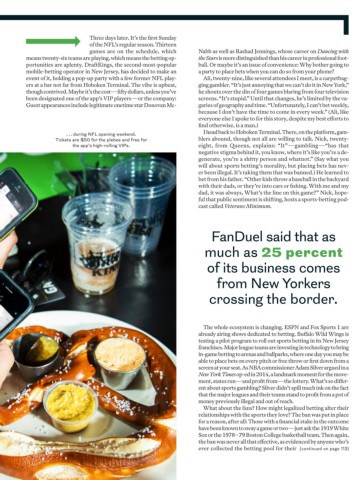
                              . . . during NFL opening weekend.
                          Tickets are $50 for the plebes and free for                    blers abound, though not all are willing to talk. Nick, twenty-
                                 the app’s high-rolling VIPs.                            eight,  from  Queens,  explains:  “It”—gambling—“has  that
                                                                                         negative stigma behind it, you know, where it’s like you’re a de-
                                                                                         generate, you’re a shitty person and whatnot.” (Say what you
                                                                                         will about sports betting’s morality, but placing bets has nev-
                                                                                         er been illegal. It’s taking them that was banned.) He learned to
                                                                                         bet from his father. “Other kids throw a baseball in the backyard
                                                                                         with their dads, or they’re into cars or fishing. With me and my
                                                                                         dad, it was always, What’s the line on this game?” Nick, hope-
                                                                                         ful that public sentiment is shifting, hosts a sports-betting pod-
                                                                                         cast called Veterans Minimum.


                                                                                               FanDuel said that as


                                                                                            much as 25 percent


                                                                                             of its business comes


                                                                                                  from New Yorkers


                                                                                              crossing the border.


                                                                                            The whole ecosystem is changing. ESPN and Fox Sports 1 are
                                                                                         already airing shows dedicated to betting. Buffalo Wild Wings is
                                                                                         testing a pilot program to roll out sports betting in its New Jersey
                                                                                         franchises. Major league teams are investing in technology to bring
                                                                                         in-game betting to arenas and ballparks, where one day you may be
                                                                                         able to place bets on every pitch or free throw or first down from a
                                                                                         screen at your seat. As NBA commissioner Adam Silver argued in a
                                                                                         New York Times op-ed in 2014, a landmark moment for the move-
                                                                                         ment, states run—and profit from—the lottery. What’s so differ-
                                                                                         ent about sports gambling? Silver didn’t spill much ink on the fact
                                                                                         that the major leagues and their teams stand to profit from a pot of
                                                                                         money previously illegal and out of reach.
                                                                                            What about the fans? How might legalized betting alter their
                                                                                         relationships with the sports they love? The ban was put in place
                                                                                         for a reason, after all: Those with a financial stake in the outcome
                                                                                         have been known to sway a game or two—just ask the 1919 White
                                                                                         Sox or the 1978–79 Boston College basketball team. Then again,
                                                                                         the ban was never all that effective, as evidenced by anyone who’s
                                                                                         ever collected the betting pool for their  (continued on page 113)

