


Page 303 - Encyclopedia of Aquarium and Pond Fish, 3rd Edition
P. 303
WHAT TO CONSIDER    301


                                                           POND SAFETY
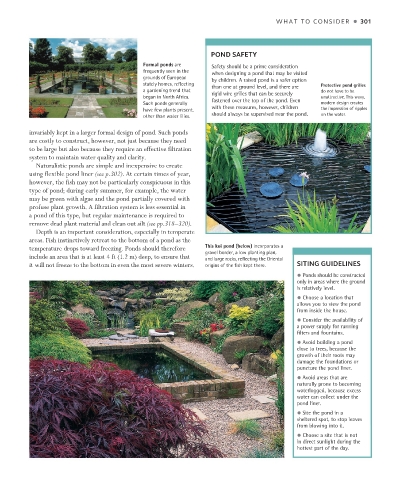
                                        Formal ponds are   Safety should be a prime consideration
                                        frequently seen in the   when designing a pond that may be visited
                                        grounds of European   by children. A raised pond is a safer option
                                        stately homes, reflecting   than one at ground level, and there are   Protective pond grilles
                                        a gardening trend that   rigid wire grilles that can be securely   do not have to be
                                        began in North Africa.   fastened over the top of the pond. Even   unattractive. This wavy,
                                        Such ponds generally                              modern design creates
                                        have few plants present,   with these measures, however, children   the impression of ripples
                                        other than water lilies.  should always be supervised near the pond.  on the water.
         invariably kept in a larger formal design of pond. Such ponds
         are costly to construct, however, not just because they need
         to be large but also because they require an effective filtration
         system to maintain water quality and clarity.
           Naturalistic ponds are simple and inexpensive to create
         using flexible pond liner (see p.302). At certain times of year,
         however, the fish may not be particularly conspicuous in this
         type of pond; during early summer, for example, the water
         may be green with algae and the pond partially covered with
         profuse plant growth. A filtration system is less essential in
         a pond of this type, but regular maintenance is required to
         remove dead plant material and clean out silt (see pp.318–320).
           Depth is an important consideration, especially in temperate
         areas. Fish instinctively retreat to the bottom of a pond as the
         temperature drops toward freezing. Ponds should therefore   This koi pond (below) incorporates a
         include an area that is at least 4 ft (1.2 m) deep, to ensure that    gravel border, a low planting plan,
                                                          and large rocks, reflecting the Oriental
         it will not freeze to the bottom in even the most severe winters.  origins of the fish kept there.  SITING GUIDELINES
                                                                                   •  Ponds should be constructed
                                                                                   only in areas where the ground
                                                                                   is relatively level.
                                                                                   •  Choose a location that
                                                                                   allows you to view the pond
                                                                                   from inside the house.
                                                                                   •  Consider the availability of
                                                                                   a power supply for running
                                                                                   filters and fountains.
                                                                                   •  Avoid building a pond
                                                                                   close to trees, because the
                                                                                   growth of their roots may
                                                                                   damage the foundations or
                                                                                   puncture the pond liner.
                                                                                   •  Avoid areas that are
                                                                                   naturally prone to becoming
                                                                                   waterlogged, because excess
                                                                                   water can collect under the
                                                                                   pond liner.
                                                                                   •  Site the pond in a
                                                                                   sheltered spot, to stop leaves
                                                                                   from blowing into it.
                                                                                   •  Choose a site that is not
                                                                                   in direct sunlight during the
                                                                                   hottest part of the day.


   US_300-303_What2cons_Sett_up_Ch.indd   301                                                        29/08/18   4:11 PM

