


Page 299 - Encyclopedia of Aquarium and Pond Fish, 3rd Edition
P. 299
ECHINODERMS     297


          Himerometra robustipinna        Culcita novaeguineae            Pseudocolochirus axiologus
         Feather Starfish                Bun Starfish                     Sea Apple

           ORIGINS  Off the coast of Southeast Asia, notably in the   ORIGINS  Widely distributed throughout the entire    ORIGINS  Found on coral reefs off Indonesia, and also on
           vicinity of Singapore and parts of Indonesia.  Indo-Pacific region.  Australia’s Great Barrier Reef.
           SIZE  7 in (18 cm).             SIZE  10 in (25 cm).             SIZE  6 in (15 cm).
           DIET  Brine shrimp and other small foods. Try to place   DIET  Mussel, clam, and shrimp meat. Offer small   DIET  Food particles in suspension. Use liquid foods. May
           the food close to the starfish to encourage it to feed.  amounts each day, removing any uneaten scraps.  also take brine shrimp.
           WATER  Temperature 77–79°F (25–26°C); alkaline   WATER  Temperature 77–79°F (25–26°C); alkaline    WATER  Temperature 77–79°F (25–26°C); alkaline
           (pH 8.1–8.3) with SG 1.020–1.024.  (pH 8.1–8.3) with SG 1.020–1.024.  (pH 8.1–8.3) with SG 1.020–1.024.
                                         When Bun Starfish are mature, their bodies fill
                                         out so much that their five legs are no longer
                                         visible. One of the heaviest of all starfish, they
                                         have spotted upperparts, but their markings and
                                         coloration are highly variable. These predatory
                                         starfish are best housed alongside nonaggressive
                                         fish, rather than in a reef setup, because they will
                                         attack sessile invertebrates, such as corals.


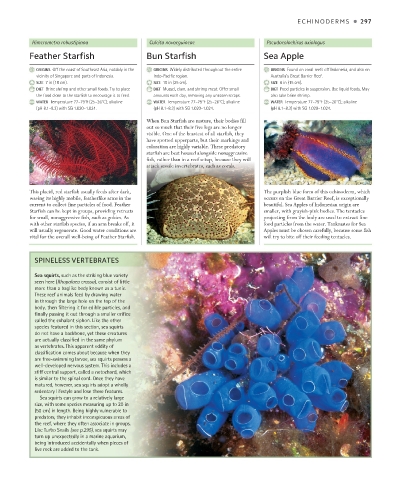
         This placid, red starfish usually feeds after dark,              The purplish-blue form of this echinoderm, which
         waving its highly mobile, featherlike arms in the                occurs on the Great Barrier Reef, is exceptionally
         current to collect fine particles of food. Feather               beautiful. Sea Apples of Indonesian origin are
         Starfish can be kept in groups, providing retreats               smaller, with grayish-pink bodies. The tentacles
         for small, nonaggressive fish, such as gobies. As                projecting from the body are used to extract fine
         with other starfish species, if an arm breaks off, it            food particles from the water. Tankmates for Sea
         will usually regenerate. Good water conditions are               Apples must be chosen carefully, because some fish
         vital for the overall well-being of Feather Starfish.            will try to bite off their feeding tentacles.


           SPINELESS VERTEBRATES

           Sea squirts, such as the striking blue variety
           seen here (Rhopalaea crassa), consist of little
           more than a baglike body known as a tunic.
           These reef animals feed by drawing water
           in through the large hole on the top of the
           body, then filtering it for edible particles, and
           finally passing it out through a smaller orifice
           called the exhalant siphon. Like the other
           species featured in this section, sea squirts
           do not have a backbone, yet these creatures
           are actually classified in the same phylum
           as vertebrates. This apparent oddity of
           classification comes about because when they
           are free-swimming larvae, sea squirts possess a
           well-developed nervous system. This includes a
           stiff central support, called a notochord, which
           is similar to the spinal cord. Once they have
           matured, however, sea squirts adopt a wholly
           sedentary lifestyle and lose these features.
             Sea squirts can grow to a relatively large
           size, with some species measuring up to 20 in
           (50 cm) in length. Being highly vulnerable to
           predators, they inhabit inconspicuous areas of
           the reef, where they often associate in groups.
           Like Turbo Snails (see p.295), sea squirts may
           turn up unexpectedly in a marine aquarium,
           being introduced accidentally when pieces of
           live rock are added to the tank.


   US_296-297_Echinoderms.indd   297                                                                 29/08/18   4:11 PM

