


Page 12 - The Rough Guide to Myanmar (Burma)
P. 12
10  INTRODUCTION
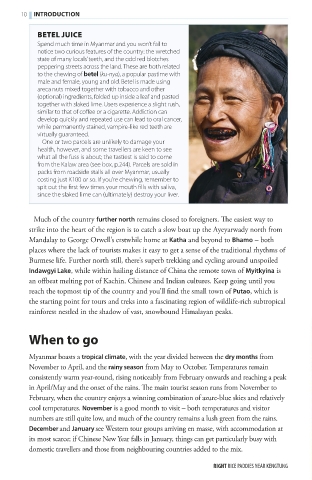
          BETEL JUICE
          Spend much time in Myanmar and you won’t fail to
          notice two curious features of the country: the wretched
          state of many locals’ teeth, and the odd red blotches
          peppering streets across the land. These are both related
          to the chewing of betel (ku-nya), a popular pastime with
          male and female, young and old. Betel is made using
          areca nuts mixed together with tobacco and other
          (optional) ingredients, folded up inside a leaf and pasted
          together with slaked lime. Users experience a slight rush,
          similar to that of coffee or a cigarette. Addiction can
          develop quickly and repeated use can lead to oral cancer,
          while permanently stained, vampire-like red teeth are
          virtually guaranteed.
           One or two parcels are unlikely to damage your
          health, however, and some travellers are keen to see
          what all the fuss is about; the tastiest is said to come
          from the Kalaw area (see box, p.244). Parcels are sold in
          packs from roadside stalls all over Myanmar, usually
          costing just K100 or so. If you’re chewing, remember to
          spit out the first few times your mouth fills with saliva,
          since the slaked lime can (ultimately) destroy your liver.

         Much of the country further north remains closed to foreigners. The easiest way to
        strike into the heart of the region is to catch a slow boat up the Ayeyarwady north from
        Mandalay to George Orwell’s erstwhile home at Katha and beyond to Bhamo – both
        places where the lack of tourists makes it easy to get a sense of the traditional rhythms of
        Burmese life. Further north still, there’s superb trekking and cycling around unspoiled
        Indawgyi Lake, while within hailing distance of China the remote town of Myitkyina is
        an offbeat melting pot of Kachin, Chinese and Indian cultures. Keep going until you
        reach the topmost tip of the country and you’ll find the small town of Putao, which is
        the starting point for tours and treks into a fascinating region of wildlife-rich subtropical
        rainforest nestled in the shadow of vast, snowbound Himalayan peaks.

        When to go

        Myanmar boasts a tropical climate, with the year divided between the dry months from
        November to April, and the rainy season from May to October. Temperatures remain
        consistently warm year-round, rising noticeably from February onwards and reaching a peak
        in April/May and the onset of the rains. The main tourist season runs from November to
        February, when the country enjoys a winning combination of azure-blue skies and relatively
        cool temperatures. November is a good month to visit – both temperatures and visitor
        numbers are still quite low, and much of the country remains a lush green from the rains.
        December and January see Western tour groups arriving en masse, with accommodation at
        its most scarce; if Chinese New Year falls in January, things can get particularly busy with
        domestic travellers and those from neighbouring countries added to the mix.

                                                   RIGHT RICE PADDIES NEAR KENGTUNG


   001-021_Myanmar-B2_Intro.indd   10                          30/06/17   4:06 pm

