


Page 13 - The Rough Guide to Myanmar (Burma)
P. 13
INTRODUCTION  11
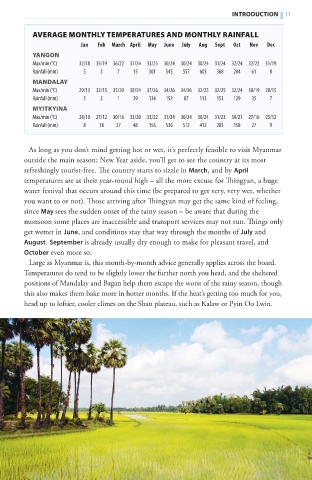
         AVERAGE MONTHLY TEMPERATURES AND MONTHLY RAINFALL
                    Jan   Feb  March  April   May   June   July   Aug   Sept   Oct   Nov   Dec
         YANGON
         Max/min (°C)   32/18  35/19  36/22  37/24  33/25  30/24  30/24  30/24  31/24  32/24  32/22  31/19
         Rainfall (mm)   5   3   7   15   301   545   557   603   368   204   61   8
         MANDALAY
         Max/min (°C)   29/13  32/15  35/20  38/24  37/26  34/26  34/26  32/25  32/25  32/24  30/19  28/15
         Rainfall (mm)   5   2   1   39   134   153   87   113   153   129   35   7
         MYITKYINA
         Max/min (°C)   24/10  27/12  30/16  33/20  33/22  31/24  30/24  30/24  31/23  30/21  27/16  25/12
         Rainfall (mm)   8   18   27   48   156   536   512   412   283   158   27   9

        As long as you don’t mind getting hot or wet, it’s perfectly feasible to visit Myanmar
       outside the main season; New Year aside, you’ll get to see the country at its most
       refreshingly tourist-free. The country starts to sizzle in March, and by April
       temperatures are at their year-round high – all the more excuse for Thingyan, a huge
       water festival that occurs around this time (be prepared to get very, very wet, whether
       you want to or not). Those arriving after Thingyan may get the same kind of feeling,
       since May sees the sudden onset of the rainy season – be aware that during the
       monsoon some places are inaccessible and transport services may not run. Things only
       get wetter in June, and conditions stay that way through the months of July and
       August. September is already usually dry enough to make for pleasant travel, and
       October even more so.
        Large as Myanmar is, this month-by-month advice generally applies across the board.
       Temperatures do tend to be slightly lower the further north you head, and the sheltered
       positions of Mandalay and Bagan help them escape the worst of the rainy season, though
       this also makes them bake more in hotter months. If the heat’s getting too much for you,
       head up to loftier, cooler climes on the Shan plateau, such as Kalaw or Pyin Oo Lwin.


   001-021_Myanmar-B2_Intro.indd   11                          30/06/17   4:06 pm

