


Page 359 - The Rough Guide to Myanmar (Burma)
P. 359
History CONTEXTS  357
       History


       Myanmar’s past reflects its unique geographical location at the cultural
       watershed between China, Southeast Asia and the Indian subcontinent, and
       the country has been buffeted throughout its history by the rival claims of
       competing kingdoms and cultures – not to mention the conflicting demands
       of its numerous ethnic groups and the traumatic effects of colonial
       occupation. Myanmar’s tendency to disintegrate into competing kingdoms
       (often divided along ethnic lines) has been a repeated feature of its history,
       like a kind of tropical Yugoslavia, and the threat of imminent Balkanization
       continues to hang over the country right up to the present day.
       Physically, Myanmar grew up around its great river valleys, particularly the mighty
       Ayeyarwady – a cradle of civilization every bit as impressive as the Ganges, Indus or
       Nile. Culturally, the unifying effect of Theravada Buddhism has played a major role in
       uniting Bamar, Mon and other Burmese peoples throughout their history, although
       significant Christian and Muslim minorities remain.
        Written records of early Burmese history are slight: much of what is known about
       the Pyu – the first recorded settlers – for example, comes from Chinese annals (and the
       now extinct Pyu language itself wasn’t deciphered until the early twentieth century),
       while even some quite basic assumptions about Burmese history have been repeatedly
       questioned. Many details remain politically charged to this day (the exact role of the
       Mon in the development of the Bagan Empire, for example). Early dates can also be
       problematic – two different dating systems exist for the rulers of Bagan, for instance,
       meaning that sources don’t always agree.

       Prehistory
       The first modern humans, Homo erectus, are thought to have arrived in Myanmar as
 BURMESE SCRIPT
       early as 750,000 BC, settling around the Ayeyarwady River. Homo sapiens appear to
       have been present in Myanmar since at least 11,000 BC, judging by archeological finds
       from the Padah-Lin Caves near Taunggyi, including pieces of charcoal, stone tools,
       fragments of bone and simple cave paintings in red ochre.
        By 1500 BC, the inhabitants of Myanmar had spread along the Ayeyarwady and
       Chindwin rivers and out into the areas that now form Shan and Kachin states.
       Inhabitants of the copper-rich Shan hills had begun to smelt bronze, while in the river
       valleys the art of growing rice had also been mastered – although perhaps the most
       notable achievement of the early Burmese is to have been among the first people in
       the world to domesticate the chicken. By 500 BC, villages in the vicinity of modern
       Mandalay were producing iron, while there is also evidence of trade both locally and
       as far afield as China – a precursor of the human migrations from southern China into
       Myanmar that were to prove so crucial in the country’s early development.


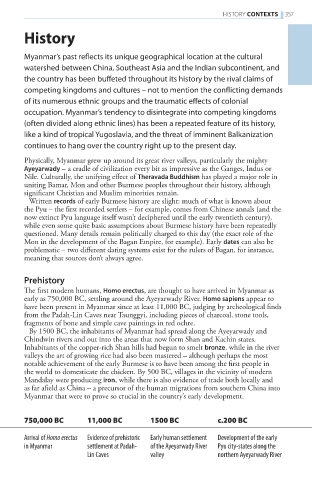
       750,000 BC    11,000 BC      1500 BC         c.200 BC
       Arrival of Homo erectus   Evidence of prehistoric   Early human settlement   Development of the early
       in Myanmar    settlement at Padah-  of the Ayeyarwady River   Pyu city-states along the
                     Lin Caves      valley          northern Ayeyarwady River


   356-402_Myanmar_B2_Contexts.indd   357                      30/06/17   2:21 pm

